


New here? Hi, I’m Alex Lindahl, Creator in Residence at Clay. You can find me on GTM Engineering YouTube channel, X where I post daily GTM plays, and r/gtmengineering where I host weekly AMAs. Connect with me on LinkedIn.
Join 9,200+ GTM operators from OpenAI, Reddit, a16z, Figma and others who subscribe to learn how the fastest growing companies use AI in GTM.
I’m chronically online and these are the 5 big ideas I came across this week.
But first, a couple of fun things and a short rant after reading the Foursquare post mortem.
My Grok Bot for Clay guide is up on SpaceXSI. Honestly, kinda cool. I never thought I’d publish something on their website. It’s another example of how writing online can lead to unique opportunities.
It also takes guts. The Foursquare post mortem this week hit hard. The app defined a mobile era. Social and real time location sharing collided for the first time. After 17 years, the company was acquired. No one made any money. A real kick in the balls for their employees. I have so much respect for Dennis Crowley for sharing this. Despite the outcome, the company inspired many in tech.


This is why I hate it when leadership defines getting equity as a meaningful form of compensation. It’s not. It’s a lottery ticket. An incredible amount of well time events and company successes need to play out to make any money. I’ve been a part of 8 startups. Joined all of them at Series A. 4 became unicorns (including Clay). There’s still no life changing money. But don’t get me wrong, I have much gratitude for the one exit (Acquia at $1B, 15th employee) that resulted in a sizable mortgage down payment. And then there’s Snyk - the darling of the cybersecurity industry for a couple years. Snyk rose to $8.7B in valuation. I paid 6 figures in taxes when I left. The share price now? Plummeted. They raised nearly $1B. That means $1B needs to go back to investors before employees get anything. I’ll save that for another post and full breakdown of all the companies and financial results so far.
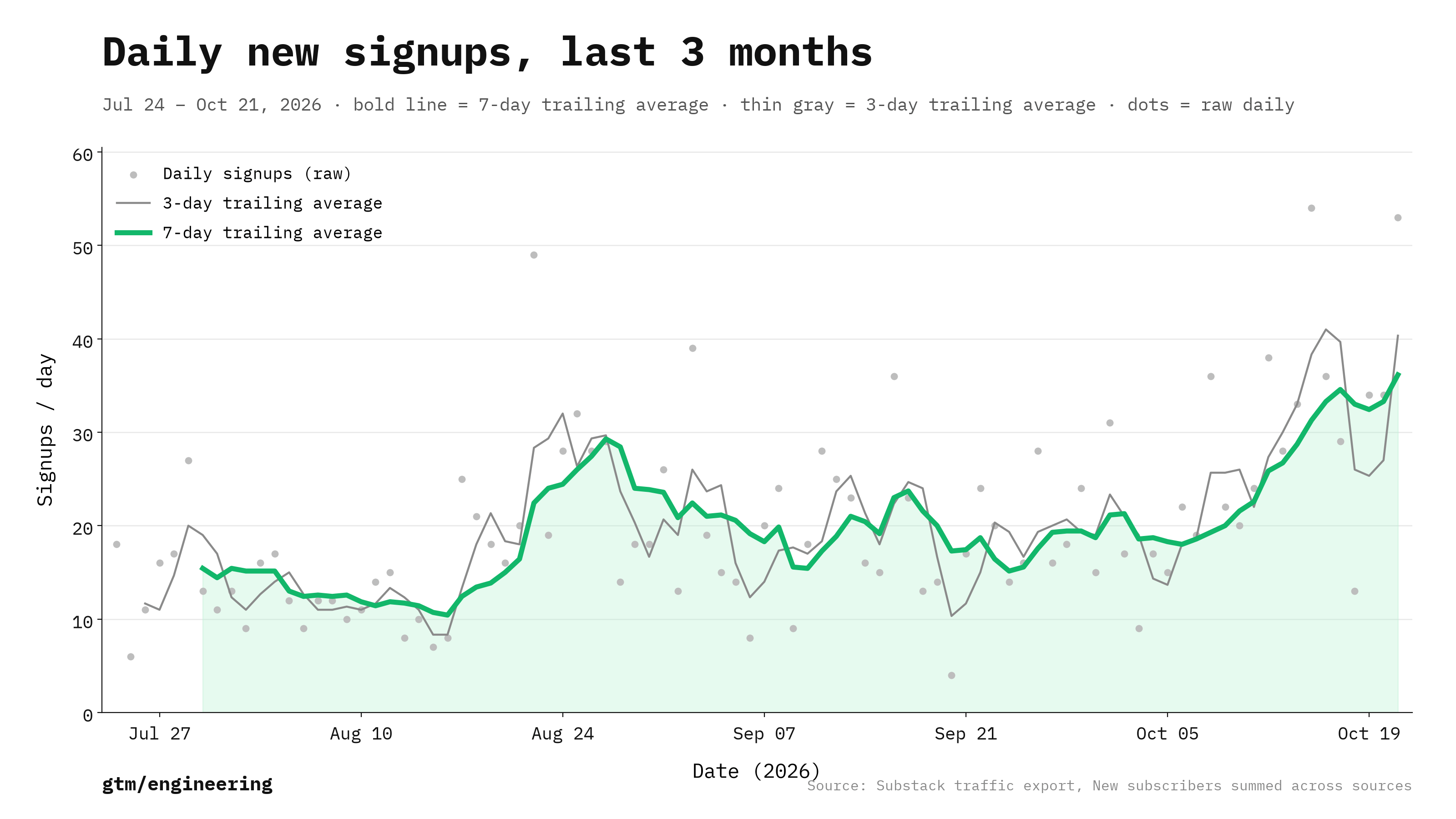
On a more positive note - newsletter growth is starting to take off. The average daily signups have been going from 10 👉 15 👉 20 👉 30.
Oh btw, here’s a cool way to analyze Substack subscriber growth.
Download subscriber data
Upload to your LLM
Ask it for analysis
This is one of the charts I got from Grok Bot:
And speaking of Grok Bot - I’m hosting a webinar with the SpaceXSI team on how to use Grok Bot and Clay.
One last thought, companies are positioning themselves in more wild ways. Cold Caked launched and described themselves as the Palantir of booking meetings:


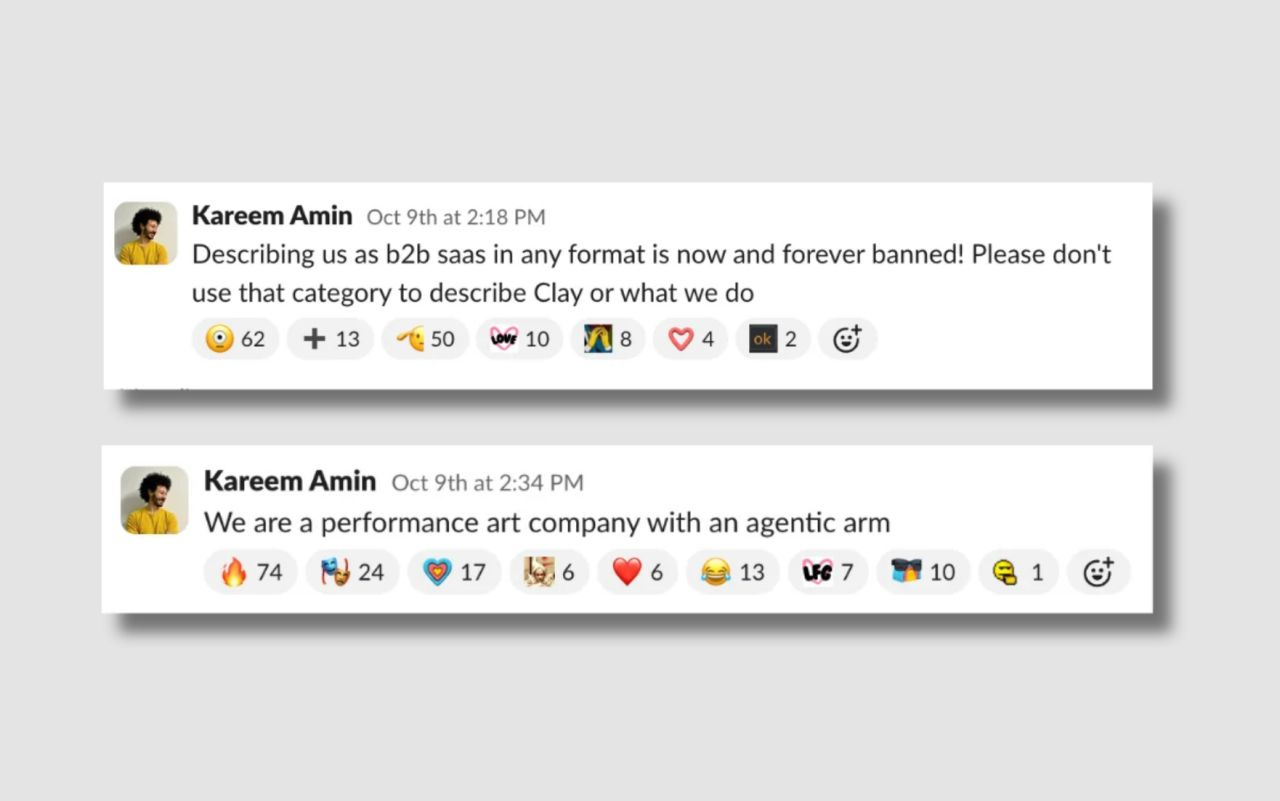
Love it. And here’s Clay’s rebranding:
And now for the 5 BIG GTM ideas from the week:
The brewing agent war in commerce (while others welcome them in)
Voice agents that call customers (it works)
You need a frontier team (why + the Harvey marketing frontier org)
Deterministic vs. reasoning GTM workflows
The State of GTM B2B (but here’s my take)
1. The war on agents has commenced
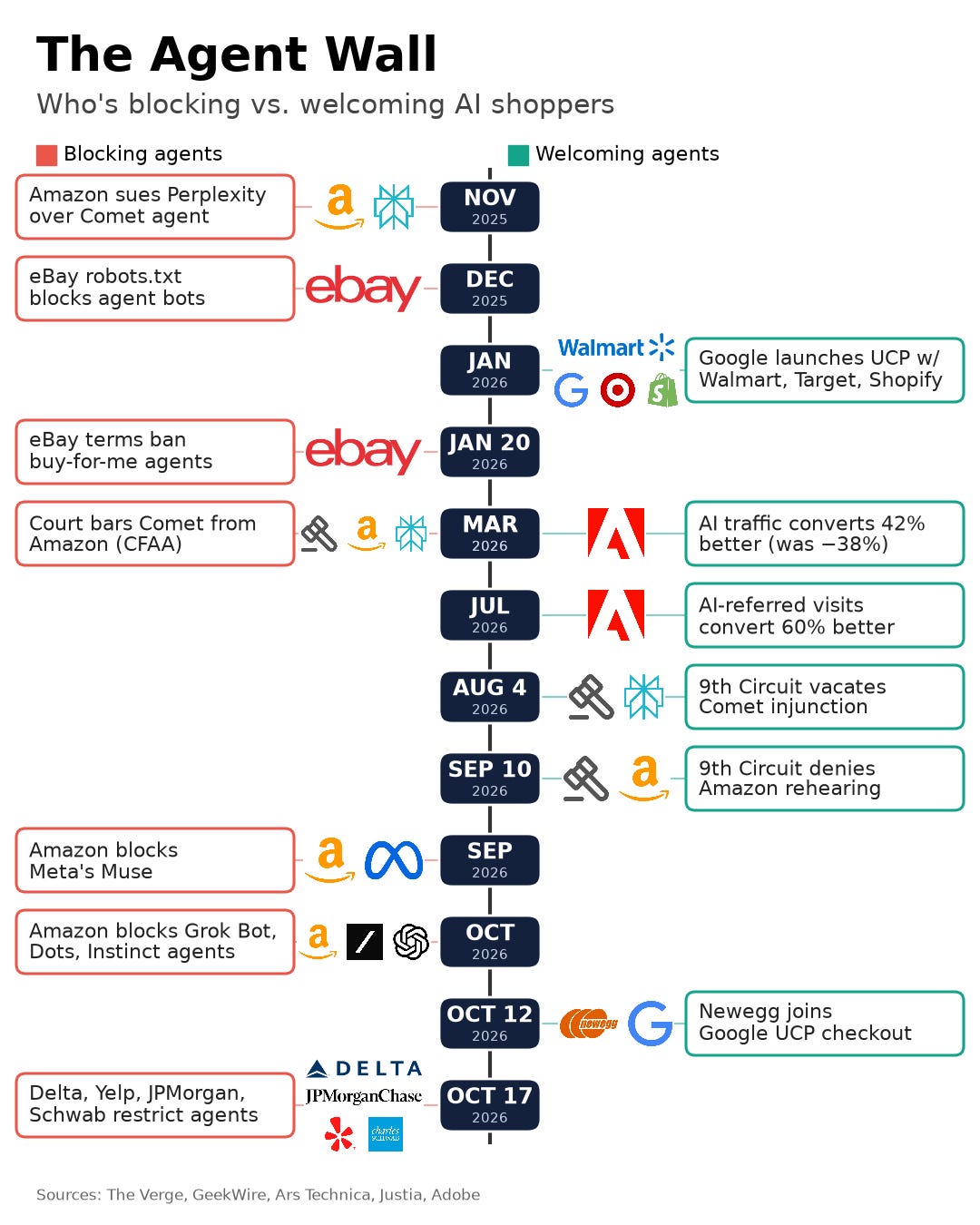
Agents can buy things for you now. That’s led to 2 different company responses:
❌ BLOCK:
Amazon: sued Perplexity over Comet, then blocked Meta’s Muse, Grok Bot, and OpenAI’s agents
eBay: robots.txt blocks agent bots, and its user agreement bans “buy-for-me agents”
Delta: stops agents from booking tickets
Yelp: only lets in agents that pay for its data
JPMorgan Chase and Schwab: keep agents out of customer accounts, citing security
✅ WELCOME:
Walmart: put its Sparky agent inside ChatGPT and co-built Google’s agent checkout standard
Shopify: merchants’ products show up in ChatGPT, Gemini, Copilot, and Meta by default
Target, Wayfair, Etsy: co-developed Google’s Universal Commerce Protocol
Newegg: joined Google’s agent checkout on Oct 12
Instacart: full checkout inside ChatGPT across 1,800+ retailers
Why would Amazon care? They generate $76B in advertising revenue every year. They need humans on the site for the ads to work. Agents represent a threat.
That raises a question… will advertising to agents become a thing?
2. Voice agents are calling customers to book mtgs
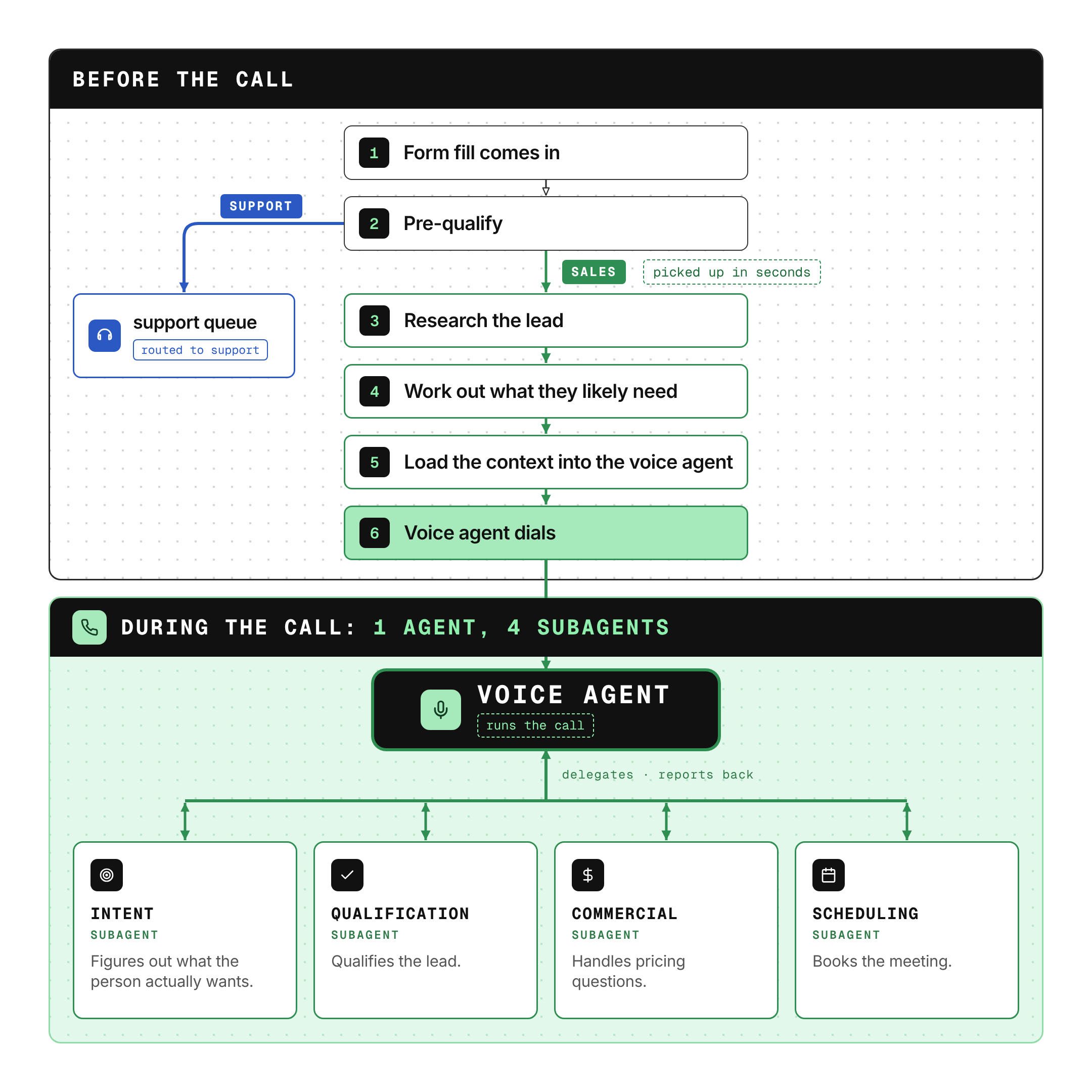
monday.com’s voice agent books 1,500 meetings a month. It calls leads, makes them laugh, qualifies them, and then finds time on the calendar.
Sounds simple. It’s not. The backend requires real time coordination with 4 subagents.
Surprisingly, customers will talk to agents. They got good feedback on it, too. I’m convinced this is the future of lead follow up. Read the full post on how Oran Akron, VP of AI GTM, rebuilt their $1B GTM engine with AI agents.
3. You need a frontier team
Every media/software company needs a frontier team. A dedicated squad tasked to absorb & understand the rapid developments of AI. The goal is focus them on experimentation so the primary workforce can focus on shipping.
Awesome episode on The Every Podcast. They built a team that balances 2 opposing personalities:
The Pirates (The Experimenters): These are your chaotic, fast-moving team members. They love testing new beta models, stringing together unstable APIs, and breaking workflows to find unexpected efficiencies.
The Architects (The Systems Builders): These are structured engineers or product minds. Their job is to take the messy, successful experiments from the “pirates” and turn them into stable, production-ready internal tools with clean code and sustainable infrastructure.
The structure of their team looks like this:
What does this look like in a software company?
Harvey shared how their frontier marketing org built agents that:
Launch videos created entirely by agents
Tailored demo videos for every customer using sales calls and account insights
Script and voice hundreds of films overnight
 Gabe Pereyra@gabepereyraHow @ShawnFarsai uses @figma @ElevenLabs and @claudeai to create hyper personalized marketing videos with agents https://t.co/5AC38xuZOV5:06 PM · Oct 21, 2026 · 119K Views31 Replies · 50 Reposts · 524 Likes

This is built using:
Product Map: agents crawled Harvey’s whole app, clicked every button, and rebuilt the key screens as Figma components. That library is the single source of truth for what the product looks like.
Motion Primitives: a Figma library of reusable animated pieces, like camera pushes, screen handoffs, a steady click rhythm, and redlines arriving in a document. A fix to one piece updates every film that uses it.
Agentic Brand Guidelines: a Figma library that works like a top-level AGENTS.md (a set of instructions agents read first). Each project folder adds its own instructions on top. They moved off markdown because words describe layout and the relationships between elements badly.
4. Deterministic vs. reasoning GTM workflows
Workflows (like what you build in Clay) are largely deterministic. There’s specific steps that are taken to produce an outcome. We’re much more comfortable with these because as humans we love control. Easier to get buy-in for and less risky (to start).
Clay also has agents, which are non-deterministic. They use reasoning, tool calls, skills, and context to produce an outcome. This incorporates more data and ultimately get to better lead qualification (as one example).
The majority of use cases are deterministic today. My sense is that this will switch to agentic / reasoning as the predominant way to get to outcomes.
5. State of B2B GTM: investment areas for 20267
My friends Kyle Poyar and Maja Voje shared the State of B2B GTM. This is GTM Strategist recap of the report.
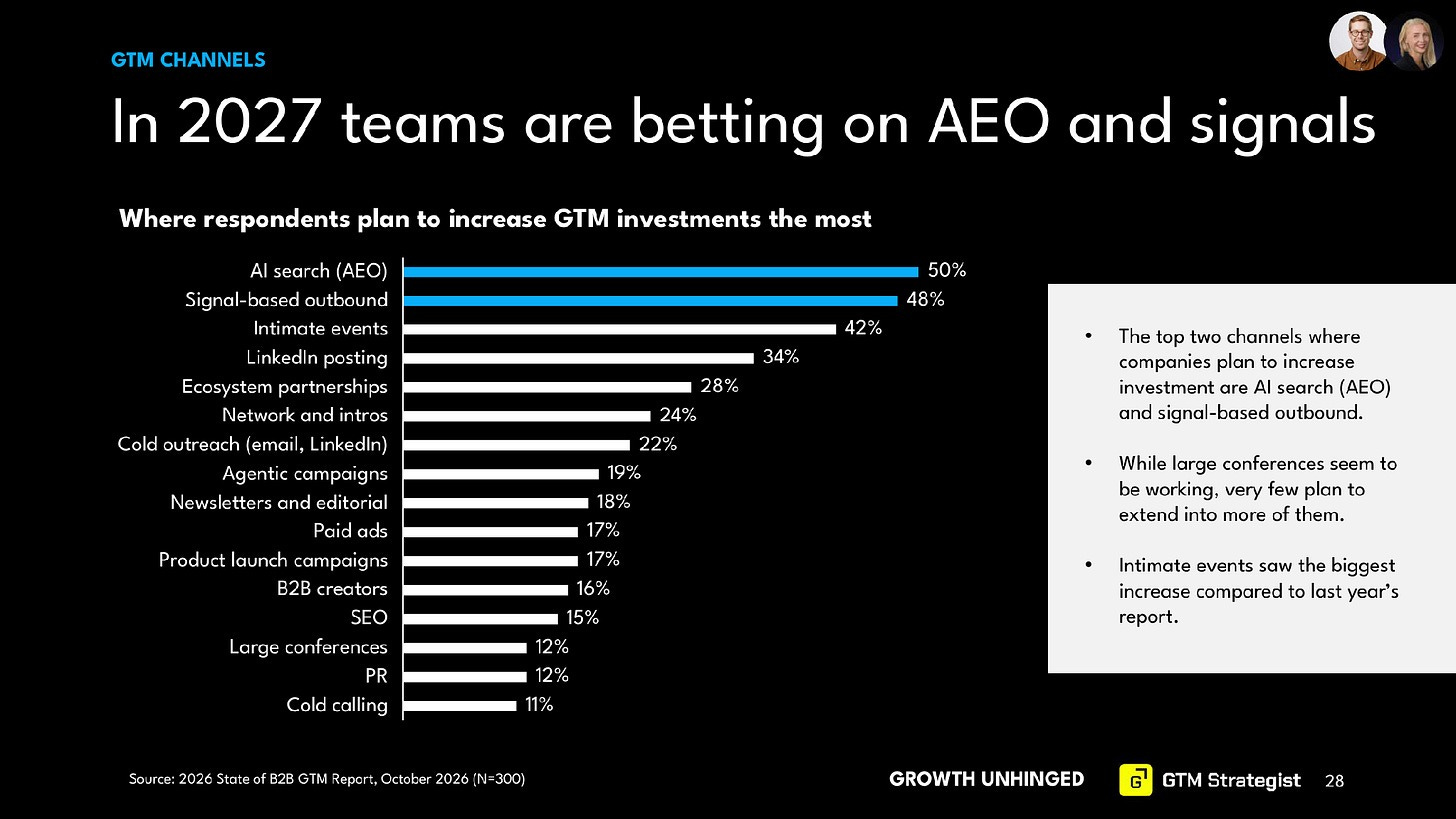
These are obvious investment areas from mainstream B2B.
This would be my top 5 areas of investment (based on what I’ve learned and what we’re doing at Clay:
Build internal media - output high end viral videos
Assemble an internal creator team - people trust people over brands
Operationalize an exec posting program - experts help them go viral
Experiment with different channels - youtube, instagram, x
Build a frontier team within GTM - experiment & then scale the cutting edge
Marketing Engineering University
Most marketing teams have added AI this year and are still rewriting what it produces, because nobody has given it any context about the company.
Matteo Tittarelli's program, Marketing Engineering University, starts there. Over four live weeks from 30 Nov, you build a company brain covering your competitors, ICP, positioning, messaging and brand voice, and then you turn your repeat work into skills and agents that use it.
He has run this with more than a dozen teams this year. Good Systems, the company behind Goodnotes, says its team "10x'd its impact", and Seapoint tripled its monthly signups at launch.
Matteo Tittarelli gave me a secret promo code to give you a discount.
Disclosure: I earn a referral fee if you enroll with my code.
Another value bomb! This newsletter is just getting better and better
Thanks so much for featuring our report https://ploy.ai/, Alex - appreciate you to the moon <3
Happy weekend