


New here? Hi, I’m Alex Lindahl, Creator in Residence at Clay. You can find me on GTM Engineering YouTube channel, X where I post daily GTM plays, and r/gtmengineering where I host weekly AMAs. Connect with me on LinkedIn.
Join 9,200+ GTM operators from OpenAI, Reddit, a16z, Figma and others who subscribe to learn how the fastest growing companies use AI in GTM.
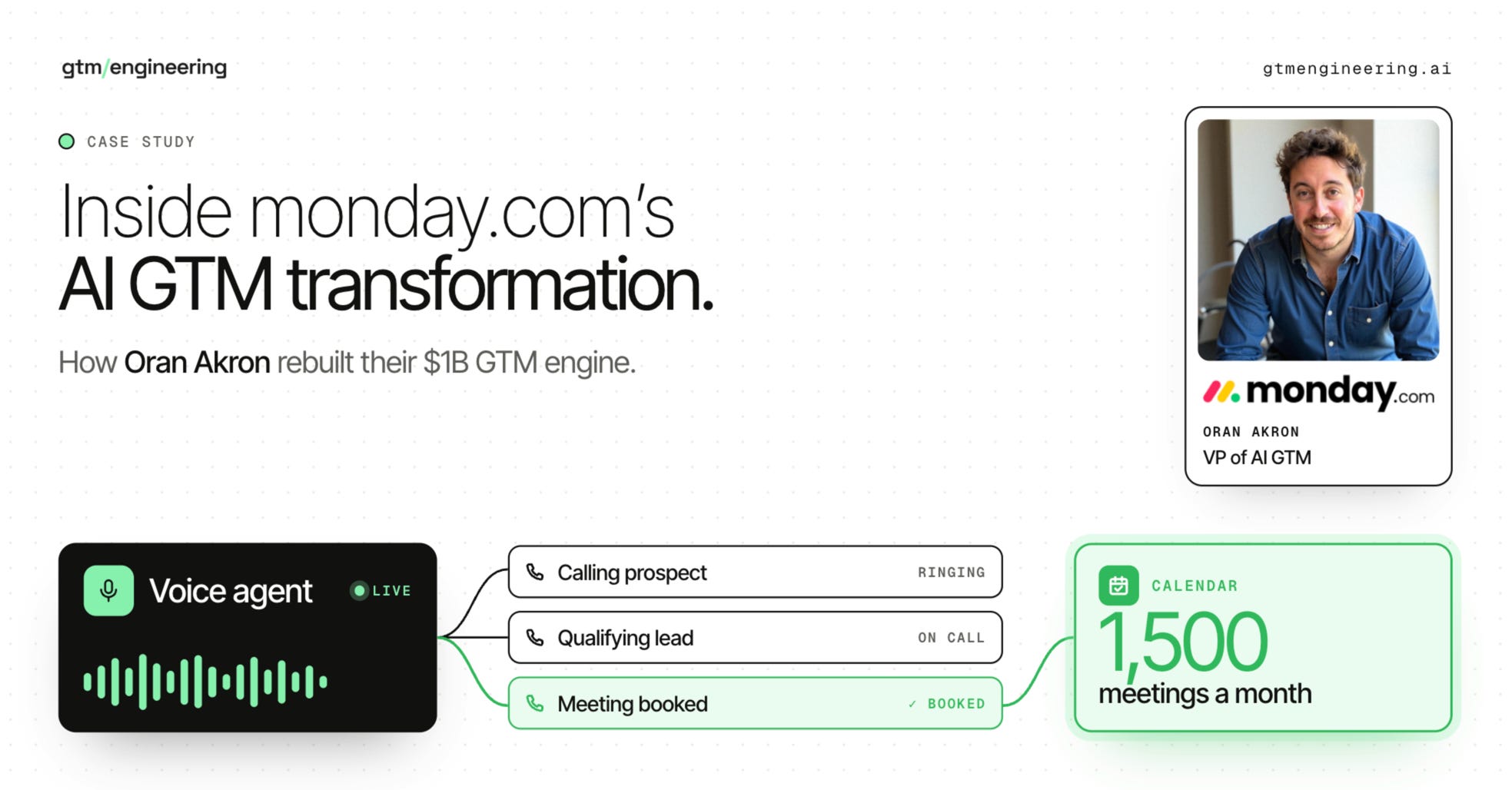
Oran Akron built and led operations at monday.com that supported org scale from 60 to 1,800+ employees. Revenue scaled from ~$10M ARR to over $1B ARR during the same period.
Over the past year, Oran became the VP of AI GTM and rebuilt their GTM systems to be AI-native. It is one of the most advanced AI implementations I’ve seen in GTM. (And, I’ve talked to 100s of Clay customers.)
In early 2025, an inbound lead at monday waited about 25 hours on average to hear back from a human. monday had tens of thousands of inbound visitors a day and a sales team spread across New York, London and Australia. It still couldn’t staff 24/7 coverage around the world.
By the time Oran left monday last week, it was < 2 minutes. An AI voice agent calls the lead, qualifies them, figures out which rep owns their region and segment, checks that rep’s calendar and books the meeting while the prospect is still on the phone. It books 1,500 meetings/month!
Oran and I have become good friends over the year. He came through the Clay studio in New York last week walk me through how they did it. The full video is coming to GTM Engineering & AI YouTube channel. This is the written version, with the parts I think other GTM teams can learn from.
In this post, you’ll learn:
What GTM agents he built for monday.com’s GTM team (and what they do)
How their voice agent wins the conversation in the first 5 seconds
What the day-to-day management of agents looks like
How team structure changed from pre-AI to AI-era
His strategy for leadership (and broader org) buy-in
Learnings from the build out.
Before diving in, you’ll also want to check out and …
Upcoming events I’m hosting:
Clay + SpaceXSI webinar: How to build GTM with Grok Bot & Clay
Cold Email AMA with Eric Nowoslawski: Submit your questions here
Enjoy!
Take the 2027 State of GTM Engineering Survey.
You’ll get 29 free GTM perks that includes
20% off Apify
1 Year of Firecrawl Hobby Plan for free
Early access to Attention Self-Serve 7 Days free.
How Oran brought GTM at monday.com into the AI-era
Eight years on a rocket ship
Oran joined monday in 2018. The company had 60 to 70 employees, around $10M ARR, and one revenue motion: self-serve. There was no CRM, no sales tech stack, no shared sales terminology. He and monday’s CRO at the time, Yoni, built the sales org from scratch, and Oran grew RevOps from himself to a global team of 70 to 80.
Today monday does roughly $1.4 to $1.5B in ARR. “It’s a rocket ship that never ends,” he said. “You never have really the time to maintain what you build.”
Each phase needed something different. 2018 and 2019 were foundations: he signed more than seven vendors in one year just to have a working motion. Around Covid it was scaling and finding new growth engines. Then offices opened globally, then came regional plays and multi-product selling, which meant reworking quota, comp and how information reached reps in the field.
Pre-AI, his org looked like most RevOps teams: regional RevOps partners for the customer-facing teams, analysts, enablement, strategy and planning. About 70 to 80 people supporting more than 1,800 people in sales, customer success, services and partners.
Pre-AI: RevOps was “the back office supporting the humans.”
AI-Era: “I managed the agents that manage customers. I became the front line of the business.”
The first meeting
In February of 2025, one of monday’s investors asked Oran to visit a company they were evaluating and give an operator’s read on it. The company was Clay. Surprisingly, Oran hadn’t heard of us.
He walked into the office. “It felt like Monday in 2019” he said.
I think it would’ve gone much different if I had treated it like a typical sales meeting. But, as Becca (our Head of Sales) likes to say “I like to go off-roading”. The meeting was more of a jam session, or mending of the minds. Our joint excitement compounded. It was clear we both shared a vision for the future GTM.
We built workflows live. I brought up my personal stash of experimental Clay tables. Spoke frankly about what works in Clay and what doesn’t. Opinions on the future of GTM. And answered a TON of rapid fire questions from Oran. It was quite fun.
He described it as “a slap in my face.”
In 2018, Oran’s team spent about a year building monday’s lead pool: enrichment, routing, scoring, dedupe and distribution for thousands of inbound leads a day, knowing which ones were sales-relevant and which rep should get them. It worked. It took a year to get right. Watching the demo, he realized he could rebuild it in a month with Clay.
“I felt, okay, we are not in the game.”
He flew back to Tel Aviv and talked it through with monday’s CEO. His pitch was simple:
If we had to build the GTM org from zero today, we wouldn’t build it the same way.
They agreed to try one flow and make it agentic.
Pick the first project for the wow, not just the ROI
This is how he got started.
Oran took one person from RevOps and one developer and picked a single top-of-funnel inbound flow. He chose a voice use case on purpose.
There were several reasons for the use case - all part of his strategy to get more buy-in to do more:
The problem: Speed to lead was bad, and he believed fixing it would lift conversion at every stage below.
Internal PR: He knew agents joining the workforce would be a change management fight, and voice had the same effect in early 2025 that ChatGPT had the first time it talked back to you.
Cool demo: He wanted a real call between an agent and a customer that people would forward to each other on WhatsApp.
It worked.
monday formalized the effort as an internal startup called Rev AI, separate from day-to-day ops, with one mandate:
Break the existing motions and rebuild them with agents.
Oran ran the team with 2 rules:
Build, don’t buy. Oran didn’t want to wait for a vendor to adopt the next model or technique. If something better shipped, his team wanted to use it that week.
Ship at 60%. “You cannot predict interaction between AI and the customers in advance. You cannot simulate all of the possibilities.” They released early and tested on real leads.
Inside the voice agent and it’s 4 subagents
There is so much more to building a voice agent than I expected.
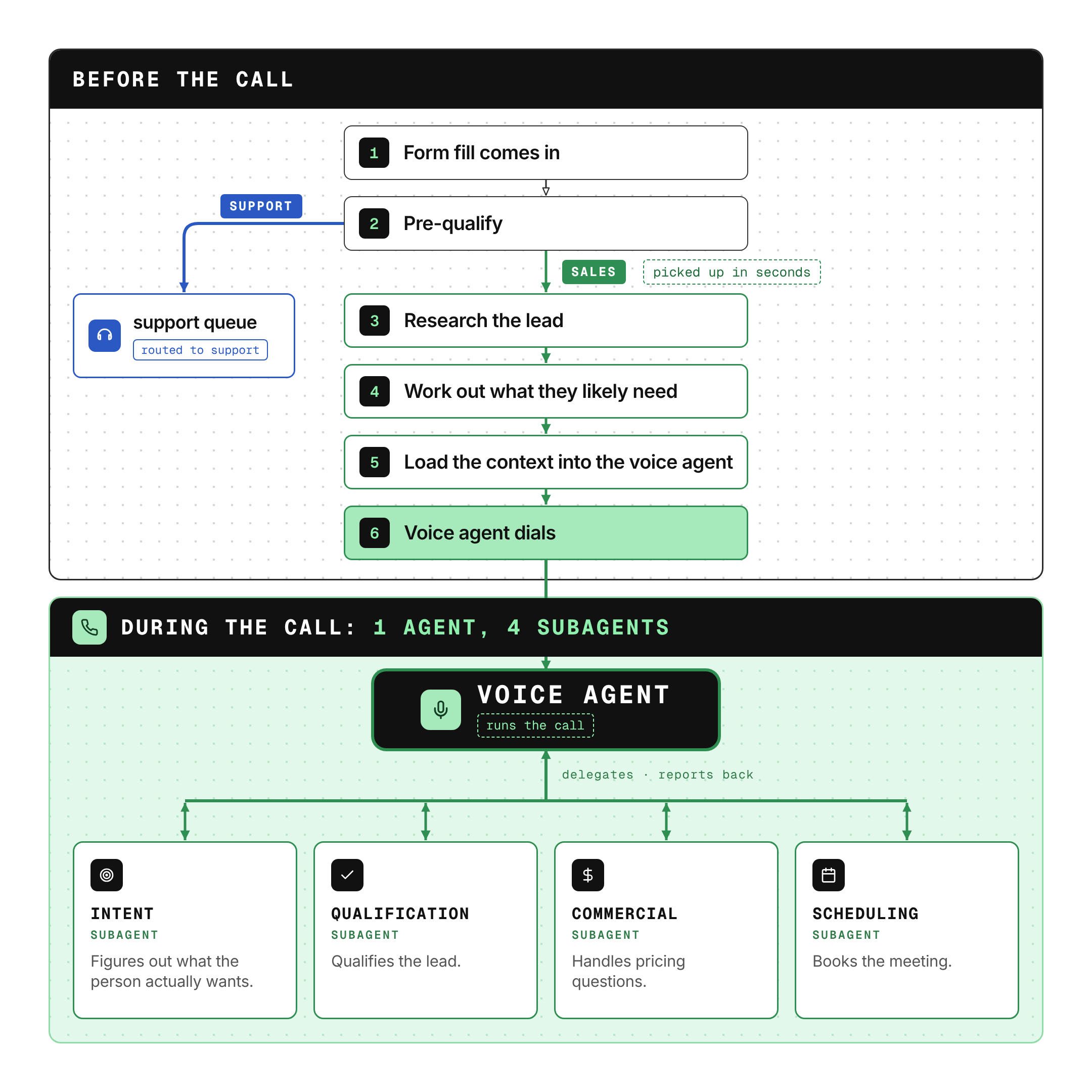
Here’s the flow. A form fill comes in and gets pre-qualified as either support or sales. Sales requests are picked up in seconds. The system researches the lead, works out what they likely need, and loads that context into the voice agent before it dials.
This is where it gets interesting.
During the call, four agents work together to support the voice agent:
an intent agent that figures out what the person actually wants
a qualification agent
a commercial agent
a scheduling agent
I had to ask, why not one agent?
Latency and hallucination.
The moment you inject too much tasks or context or instruction to one agent, then the more possibility that it will hallucinate.
Oran said the harder problem was the handoffs, passing variables from the intent agent to the qualification agent mid-conversation so the next agent picks up exactly where the last one left off. They use ElevenLabs for the voice. But it isn’t the product.
Next, they built the orchestration and semantic layer around it, partly in code, and that’s where most of the learning came from. An earlier platform treated the call as a rigid workflow, and the agent got confused and hallucinated for nearly 20 minutes.
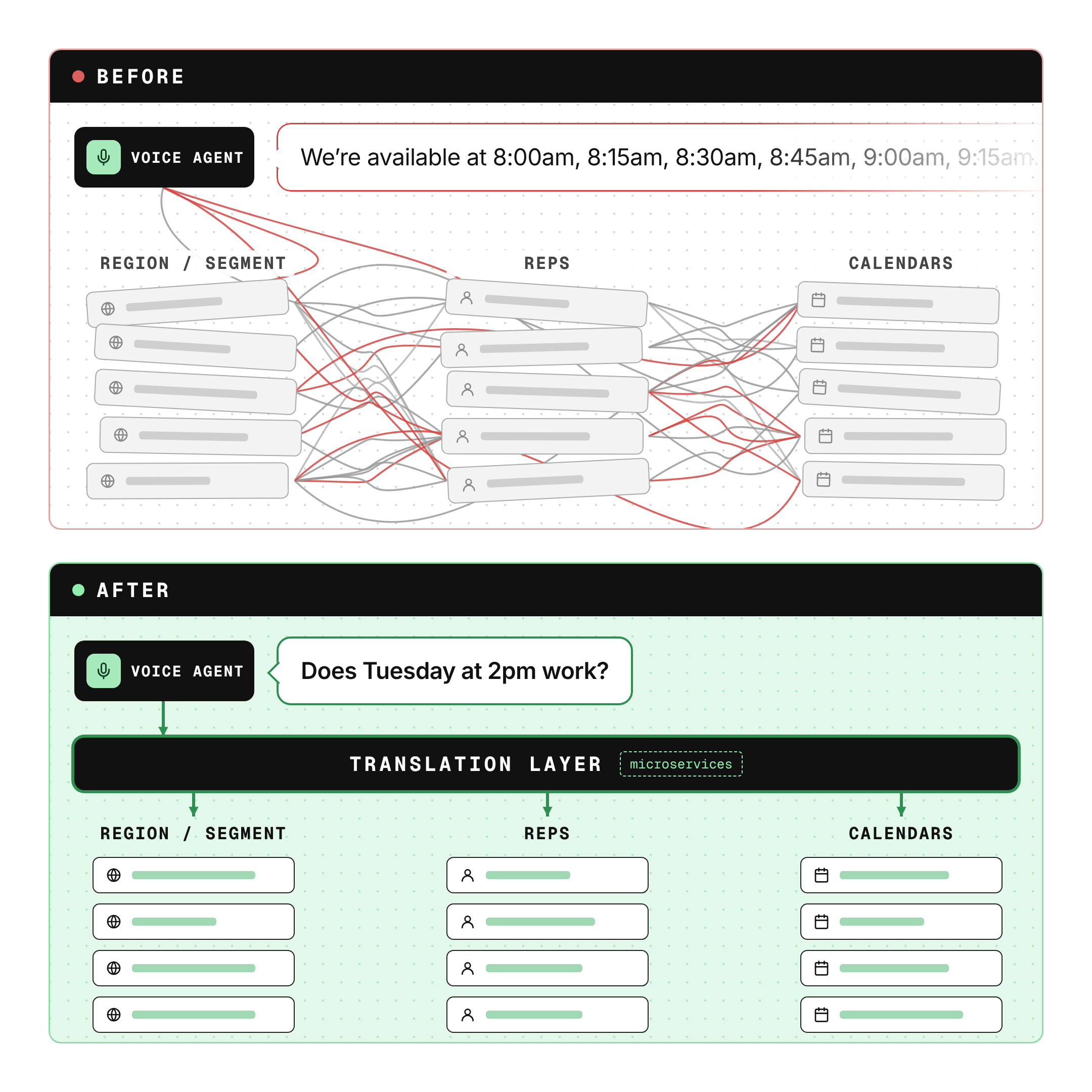
Calendars and matching availability was surprisingly hard.
The agent has to know the lead’s region and segment, map that to the right reps, then read live availability. Before they fixed it, the agent would tell prospects: “We’re available at 8am, 8:15am, 8:30am, 8:45am...” and keep going. The fix was a set of microservices between the voice model and the third-party tools (Chili Piper and the reps’ calendars) that translate those systems into something the agent can reason about. Oran also noted that agents need different calendar access than humans do, which nobody had set up for.
Then there’s phone infrastructure.
Calling at volume means rotating numbers by state through Twilio and keeping those numbers from getting flagged as spam.
The first 5 seconds are critical to win the convo
Even though I’ve been at the epi-center of GTM innovation, I’ve always been skeptical if humans will engage (and at meaningful length) with agents.
I had to ask the obvious question: do people stay on the line once they realize it’s an AI?
You’d be surprised. People love it.
Not everyone, he said, but most. The big finding was that the first five to ten seconds decide the call. Oran believes agents should have an engaging, funny personality, so the greeting is always a joke. They have recordings of prospects laughing and telling the agent it’s the best AI they’ve ever talked to.
That’s also brand. Monday wanted the agent to sound like Monday: fun and a little ahead of everyone else.
The numbers and results
On a monthly basis the inbound agents handle:
20,000+ leads
40,000+ emails
10,000 to 15,000 calls (not every lead has a phone number, and not every call is answered)
~1,500 discovery calls booked for reps
The agent works across voice, email, SMS, in-product and WhatsApp. (”In Brazil you need WhatsApp. I didn’t know that.”) Oran said the hardest part wasn’t any one channel. It was keeping one coherent context per lead across all of them, so the agent can call and say, “I wanted to follow up on the email I sent you,” the way a human rep would.
How he got leadership onboard
The biggest bottleneck for AI adoption is not the tech, or learning how apply AI. It’s gaining leadership buy-in to truly do something new. And then there’s the fast follow of change management.
monday’s leadership backed the project, but Oran said that’s not why it spread.
To be honest, 50% of my job was more change management than technology and AI.
The method was data-driven expansion. The agent got a slice of the lead population. Only when its results matched or beat the humans on that slice did it get more. They worked with reps in the field the whole way so it never felt like the agent was taking their work. Add executive support, real results and call recordings anyone in the company could listen to, and eventually other teams started coming to Rev AI asking for help with their own use cases.
What managing an agent looks like
The team was 10 people at most: AI developers, AI engineers, an AI architect, analysts, and what Oran calls agent strategists. Many of the strategists came from RevOps or product management.
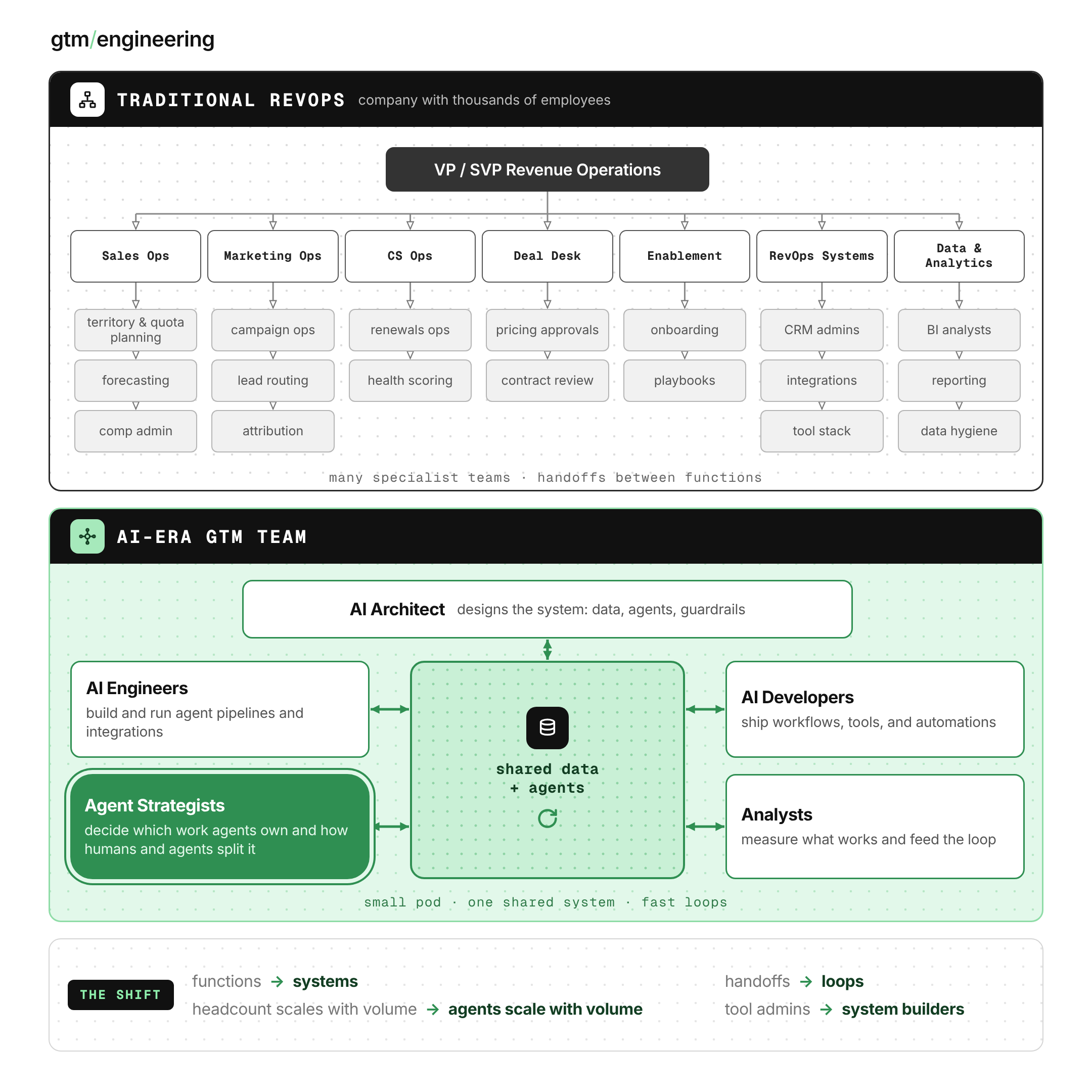
The thing that surprised him most was watching one agent strategist manage two top-of-funnel agents that were handling more than 10,000 leads in parallel. A rep might carry 50 accounts with RevOps, SDRs and CS around them. Here, one person tunes one system, “and immediately, tomorrow, you see different results.”
Every morning the team ran a ceremony. First the KPIs, to make sure everything was running. Then about 20 minutes of evals. You can’t listen to 10,000 calls, and Oran didn’t want to hire 20 people to try, so they built automated evaluation of every call and email against set criteria: agent behavior, technical failures and so on. That meeting produced action items every day, down to which individual words the agent used that moved results.
The end goal was to automate the ceremony too. On self-improvement, Oran said what’s usually missing is a definition of what good looks like. GTM has an advantage here because good is a number: a conversion, a call that hits a set of criteria. Get that defined and “you are 50% ready.” The rest is capturing and modeling the data so feedback flows back into prompts, context and tools. His ideal was a system that rewrites its own prompts and context, and even tells its manager which capability is missing. He said they got some of the way there.
Agents two and three
The voice agent was just the start. Now there’s a growing team of agents. These are the next 2 that got added:
PLG onboarding. Most people who come to Monday sign up and try it free. They didn’t come to talk to sales, so the agent’s first move couldn’t be qualification. Instead it helps them onboard and shows them the capabilities that fit what they’re trying to solve. Oran said:
Users who interacted with the agent in-platform adopted more than 50% better, and it moved conversion to paid.
Oz. The outbound agent started as account research and outreach, then grew into a copilot for reps called the OZ agent (as in Wizard of Oz). It’s an agentic layer over Monday’s systems of record, Gong, Snowflake and Salesforce, behind one interface the team built. Reps delegate tasks: pipegen outreach, CRM updates, creating and updating quotes in CPQ. Oran’s framing for it: if you manage 80 accounts today, how do you manage 200 with the same hours? Hand Oz the work that isn’t selling.
UI is commoditized, this is what’s next for reps
I asked what the rep’s interface looks like in a few years, since I go back and forth on it.
Oran has a firm view.
Pre-AI: UI was how a vendor steered you down the flow they wanted.
AI-era: Now everyone is used to iterating with ChatGPT and Claude, so the expectation has flipped: the user sets the tone, not the vendor. Chat will always be part of it, but he expects the same software to look different for every rep, designed by the rep or generated by the AI. Four hundred reps means four hundred working styles.
The real value will be behind the scene. It’s not about the UI anymore.
What’s next for Oran
Last week was Oran’s last at Monday. After eight years he’s starting his own company.
He says he keeps seeing the same pattern in companies that reach out to him for advice. They change how their engineers work with AI, move on to GTM, and get stuck. His read is that they’re treating AI as one more tool or point-solution agent dropped into an existing workflow. The question he’d ask instead is the one he asked his CEO in early 2025:
If you were building this from zero today, would you build it the same way?
He thinks there’s a two-to-three-year window that’s going to shape how GTM works, and he’d rather shape it than react to it. I’ll be following along.
I’ll let him share more about the new company when he’s ready.
Next event: Building with Grok Bot & Clay
I’ve been cooking with the SpaceXSI team on some cool upcoming content. Next week, we’re hosting a join webinar on how to build with Grok Bot & Clay.
When: Wednesday Oct 28
Time: 2:30 - 3:30PM EST
Register: sign up here
Who:
Alex Lindahl (me), Creator in Residence, Clay
Matthew Silberman, Marketing Operations, SpaceXSI
What you’ll learn
Build Clay workflows in plain language. Describe the inputs, steps, and output you want, and Grok Bot builds the workflow in Clay.
Cut outbound prep down. Automate account research, signals, contact enrichment, and personalized drafts so reps can focus on reviewing messages.
Follow up on inbound leads in minutes. Enrich the lead, assess fit, route it to the right rep, and send a personalized email in less than five minutes instead of hours or days.
Go beyond the Clay UI. Have Grok Bot fill out web forms, log into apps, remember what’s working, and pull Clay data from your phone.