


New here? Hi, I’m Alex Lindahl, Creator in Residence at Clay. Find me on GTM Engineering YouTube channel, X where I post daily GTM plays, and r/gtmengineering where I host weekly AMAs. Let’s Connect on LinkedIn.
Join 9,000+ GTM operators from OpenAI, Reddit, a16z, Figma and others who subscribe to learn how the fastest growing companies use AI in GTM.
Did you catch Tesla’s flying car demo last night? It’s bonkers:
Is this a glimpse into a Tesla / SpaceXSI merger?
Speaking of SpaceXSI - I talked to one of their Strategic AEs this week. He shared how they use Grok Bot to find warm paths into accounts at scale across the team. IMO this has never really been solved and I think this is it. More on that below.
Today’s post is a start of a new series where I share 5 big ideas in GTM that you should know about.
This week’s BIG 5:
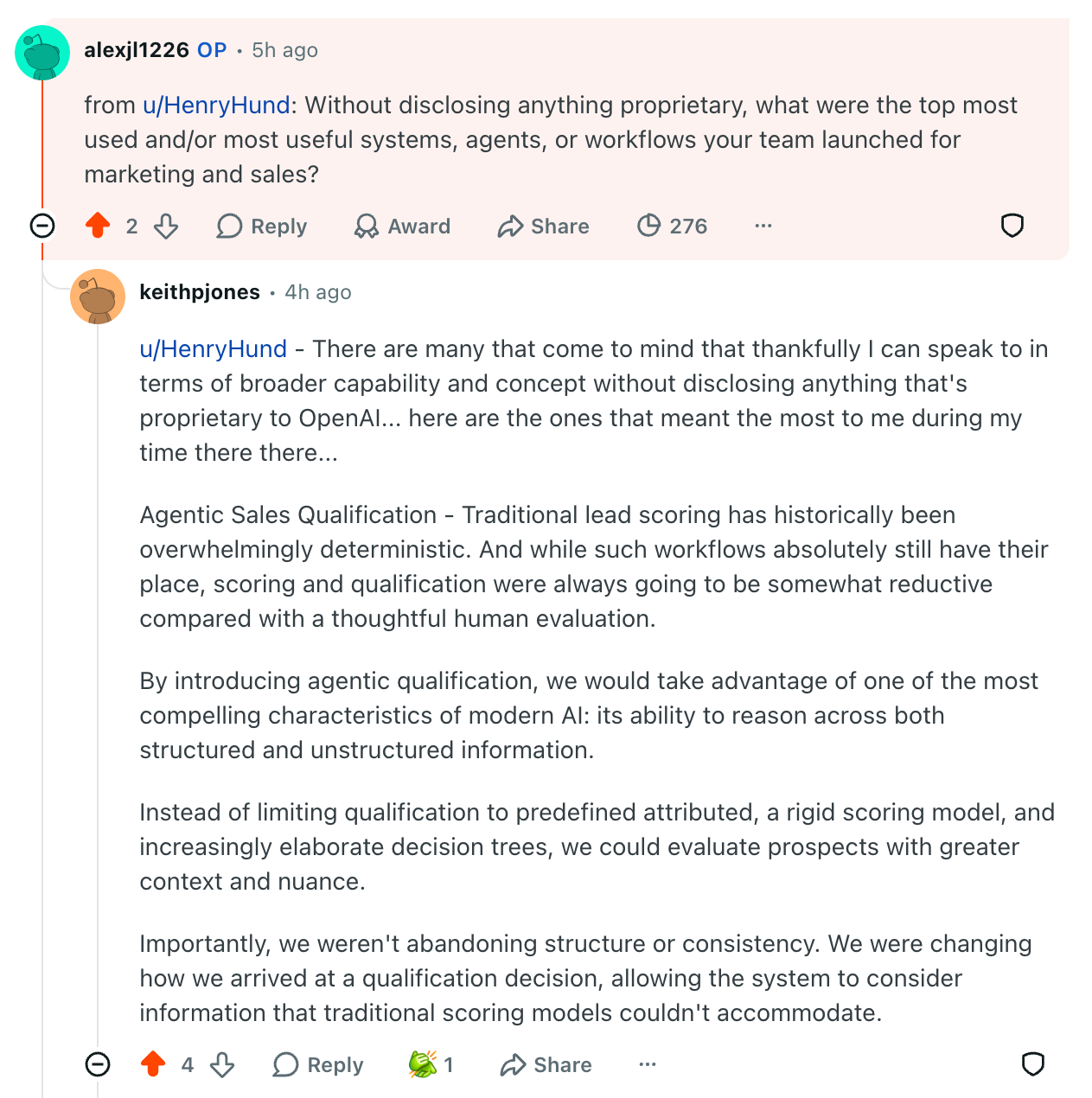
Agentic qualification at OpenAI - from the OpenAI AMA with Keith Jones
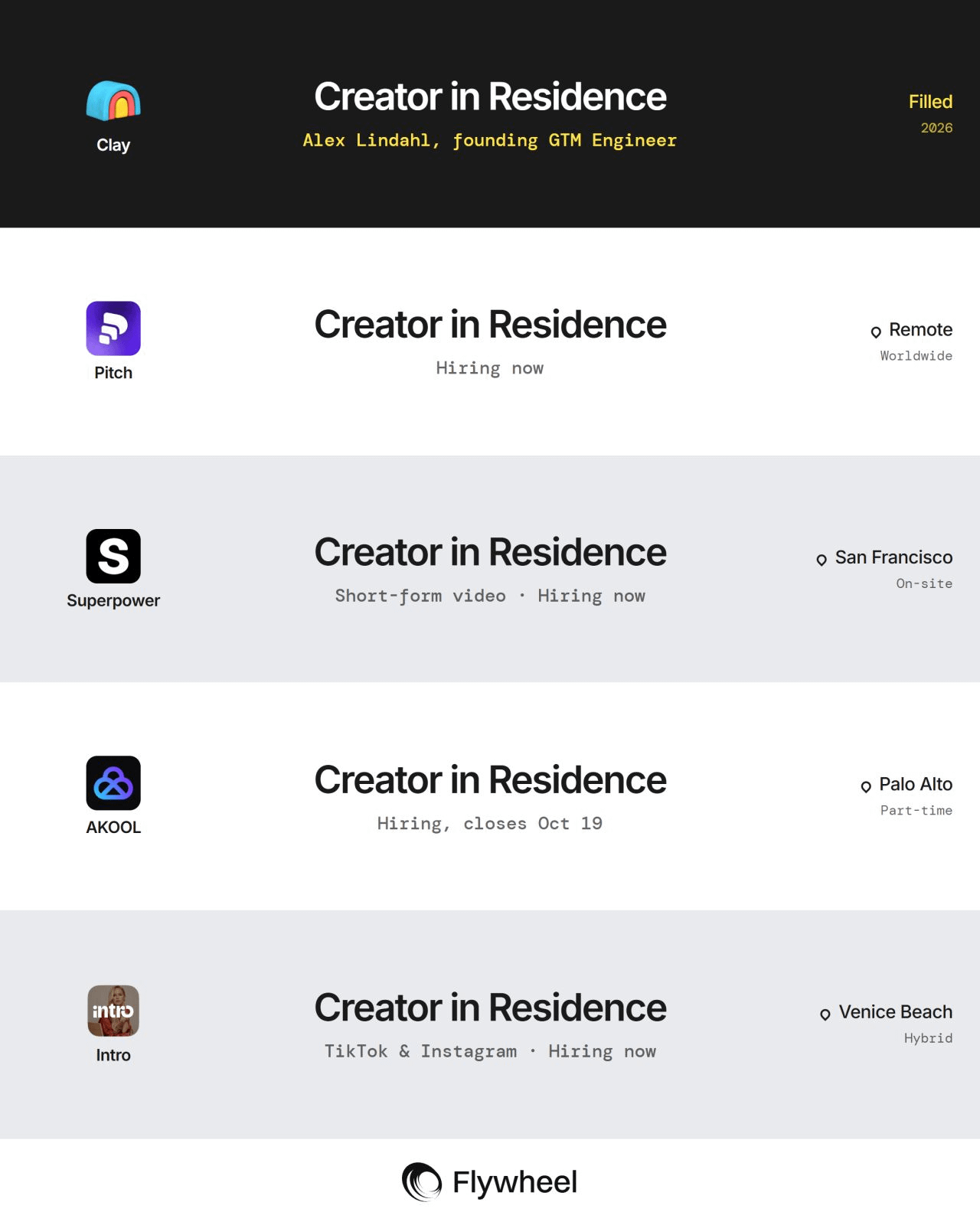
Rise of the Creator in Residence - why every marketing team will need one
Community events in nature - an event format more should copy
Ramp’s multi-player AI work system - every company needs this to ship faster
SpaceXSI’s Grok Bot warm intro path finder - how to find warm intros at scale
Plus: the Clay play of the week & how to scrape public databases.
1. Agentic qualification will replace lead scoring
Keith Jones recently left OpenAI where he was Head of GTM Systems for the last 3 years. He started a new venture, Grey Company, and held an AMA on building GTM Systems at OpenAI on r/gtmengineering yesterday. Pour yourself a bourbon and cozy up. The entire thread is worthwhile to read. I’ll post a more thorough overview soon.
Why agentic qualification will replace traditional lead scoring:
2. Rise of the Creator in Residence
Alex Saunders called this out first on LinkedIn. I’m obviously bullish since I left sales at age 40 to be a Creator in Residence at Clay. Will this become the breakout role after the GTM Engineer?
The GTM Engineer was about building the machine; Data, signals, outbound, automated end to end. The Creator in Residence is about making people want to use it. These companies already have the product. What they're investing in is distribution through a person. Someone who does the work, then shows the work.
The best marketing comes from practitioners, not from the brand account.
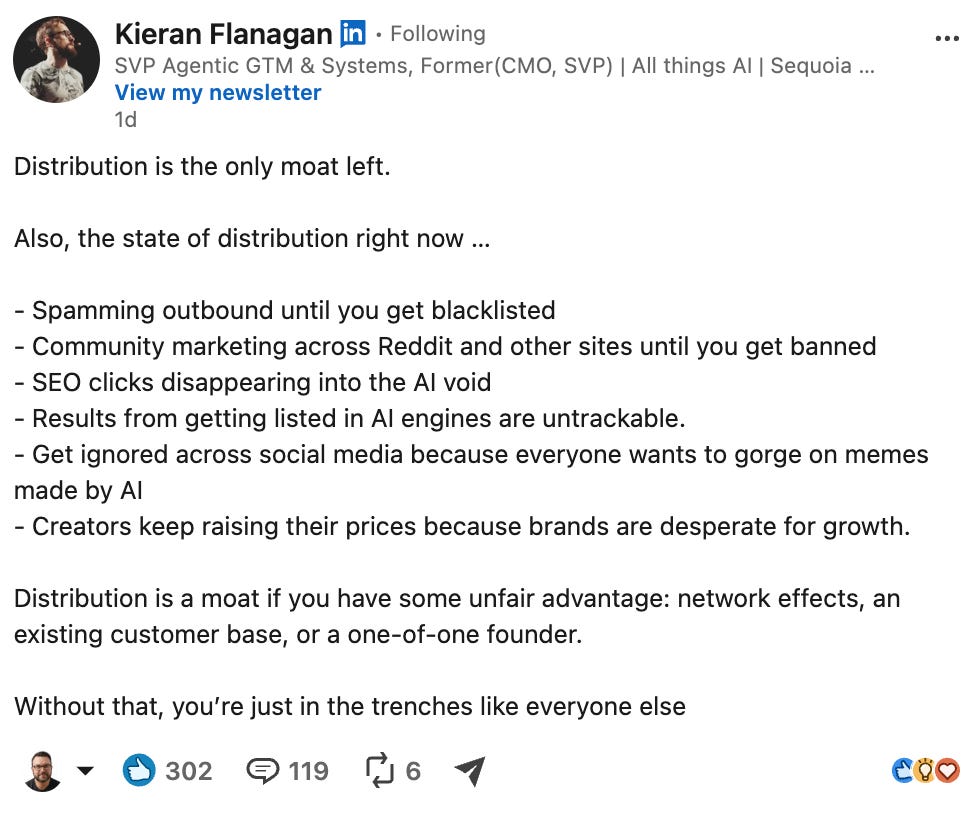
This goes hand in hand with the idea 'distribution is the last moat”:
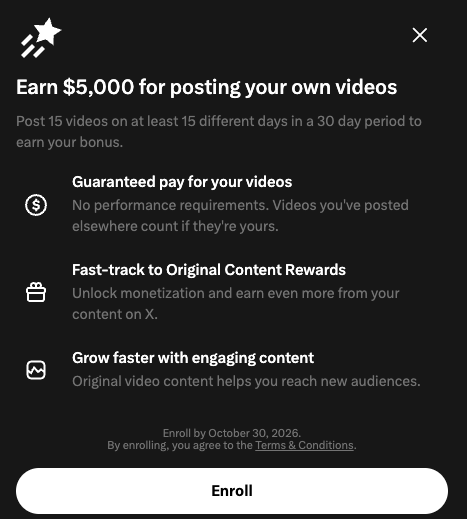
My advice - start building an internal media & creator team. Your 2027 will thank you. Platforms are putting out more incentives for UGC too. X announced this:
3. More community events in nature please
Work-Bench (a VC firm in NYC) brought 80 talented operators to a 1 day retreat in Hudson Valley this week. I got to co-lead a breakout session on “cool ass marketing”. My takeaways:
We need more events in nature. It felt more intentional. Relaxed.
Loved the socratic seminar breakout sessions.
NYC talent is cracked. Consider NYC if you plan to start a company.
David Politis former co-founder of BetterCloud, shared 5 ways to build trust (one of the most important things to do if you want to move into leadership).
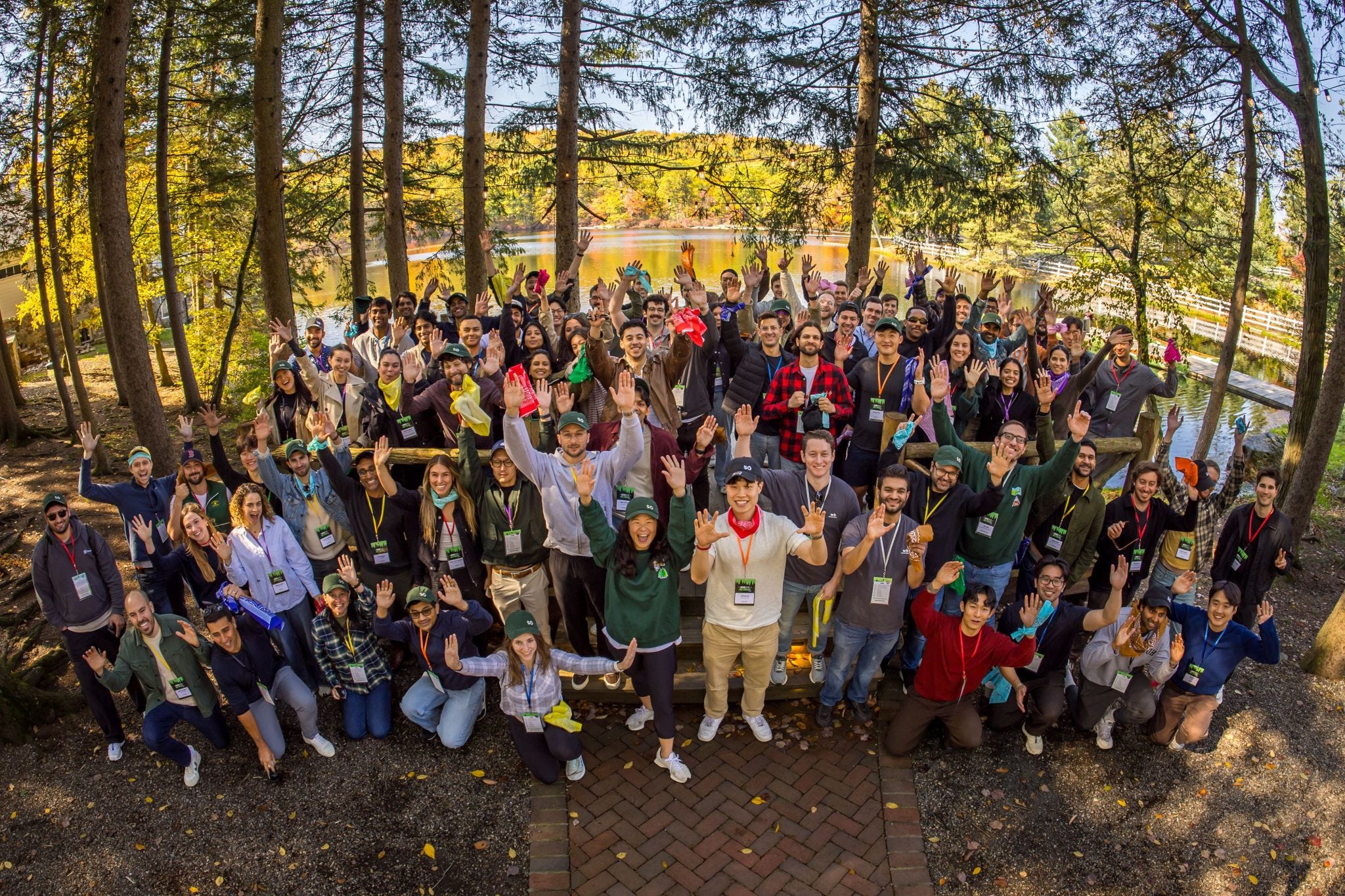
This was the format if you’re looking for event inspiration:
Keynote speaker
Fireside chat
Lunch
Scavenger hunt - this was basically time to make friends with an activity
Breakout session A - 5 group topics to choose from
Breakout session B - 5 group topics to choose from
Breakout session C - 5 group topics to choose from
Happy hour + dinner
4. Ramp’s multi-player AI system for productivity
David Senra asked Ramp’s Co-Founder, Eric Glyman “How does Ramp move so fast?”.
The answer is Ramp’s internal “Glass” AI platform that distributes skills & solutions (that were previously solved by 1 person) into the the workflows of everyone.
Rather than have me explain, let me show you.
Today, I asked Glass how many U.K. customers we’ve added since launching. It knew to exclude U.S. companies with U.K. offices because Finance taught it that months ago. I didn’t explain a thing.
A trivial improvement, you may say—not worth bothering about. But multiply that by every employee, every day, and your company gets better at work every time someone does it.
So far, 323 employees (PMs, CX agents, salespeople, marketers, analysts) have made 6,500+ edits to what Glass knows.
Take new feature requests. They used to be copied by hand into Salesforce, about 300 a month. In May, an account manager saved a prompt to Glass that pulls them straight from customer calls. Now we capture 20,000 a month. Another prompt prioritizes them. A third emails customers when something they asked for ships. More than 5,000 of those emails have gone out so far.
No model ships with your company’s brain.
5. How to use Grok Bot for finding warm paths
There’s a couple Grok Bot capabilities to understand first.
It has its own computer in the cloud. Every account comes with a full desktop, browser, and system, so the bot loads and uses web pages just like you would.
It clicks and types like a person. No API or MCP integration needed. It opens the app, reads the page, and clicks through it.
It stays logged in. Log it in once and it remembers. Cookies and sessions carry over from task to task, so it picks up where it left off.
It uses connectors when they exist. For tools with a direct integration, it skips the browser and connects straight in through connectors or MCP.
It hands you the tricky login parts (if needed). When a site asks for a password, a captcha, or a verification code, it pauses and passes that step to you instead of trying to force its way through.
This enables a Bot to log into Sales Navigator’s relationship explorer to see the common connections. Doing this just for your account isn’t that powerful. But when you have a Team Bot, it can look across everyone’s relationship explorer.
I asked if this would get flagged by LinkedIn. No one is a 100% sure, but the team doesn’t think it would get flagged for a couple reasons:
Bots mimic how a human would navigate a website
You can route your Bot traffic through your location
It doesn’t push too hard and stops when it runs into potential blockers
I haven’t tried it yet, but this super clever.
Clay play of the week: gov databases
Follow our account on X for daily use cases & workflows you can build on Clay.
A security camera company had the same problem every seller has. Their “improve workplace safety” emails sounded exactly like everyone else’s.
So they stopped guessing which accounts cared about safety.
They looked it up, in a government database.
Here’s how the play works & how to build it 👇
A security-camera company used Claygent and Operator (an AI agent that browses websites) to search OSHA severe-injury reports and complaints for each target business. It counted that business’s incidents over the past year and used the count as personalization: how its cameras help reduce exactly the kinds of incidents on that business’s record. The signal is public, specific to each account, and almost nobody else uses it.
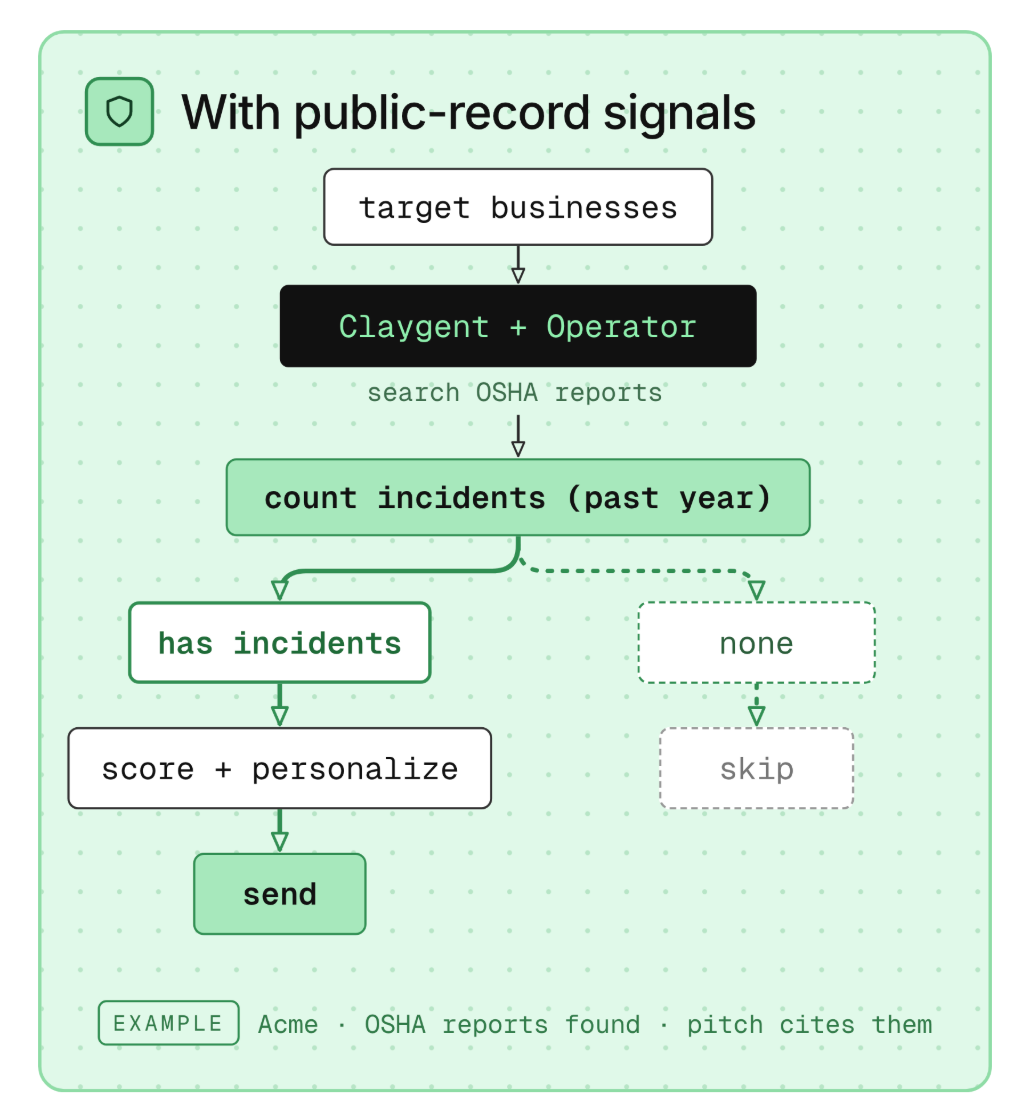
How to build it
Import target businesses into Clay along with the inputs for an OSHA report search.
Use Claygent and Operator to find each business’s severe-injury reports and complaints.
Count incidents from the past year, then score and filter the accounts that have relevant ones.
Write the evidence into approved personalization fields for the pitch.
What you need: Clay with Claygent. Effort is medium, credit usage is medium, and you can see value the same week.
Who it’s for: GTM engineers, SDRs, and AEs.
What you get: A scored list of accounts with incident evidence attached, plus personalized outreach copy.
Watch for: Injury records are sensitive. Keep the tone helpful rather than accusatory, have a human approve the copy, and double-check that each record matches the right business location. The source was a hackathon project, so it’s a proven concept but not yet a production result.