


Welcome to The GTM Engineering Newsletter. Hi, I’m Alex, one of the first GTM Engineers at Clay. My goal is to help you skill up on AI and build modern GTM growth systems. Over the past 2 years, I’ve helped NVIDIA, Reddit, Twilio, Atlassian, and many others build with Clay & AI. Join 7,500+ GTM operators, founders, and investors.
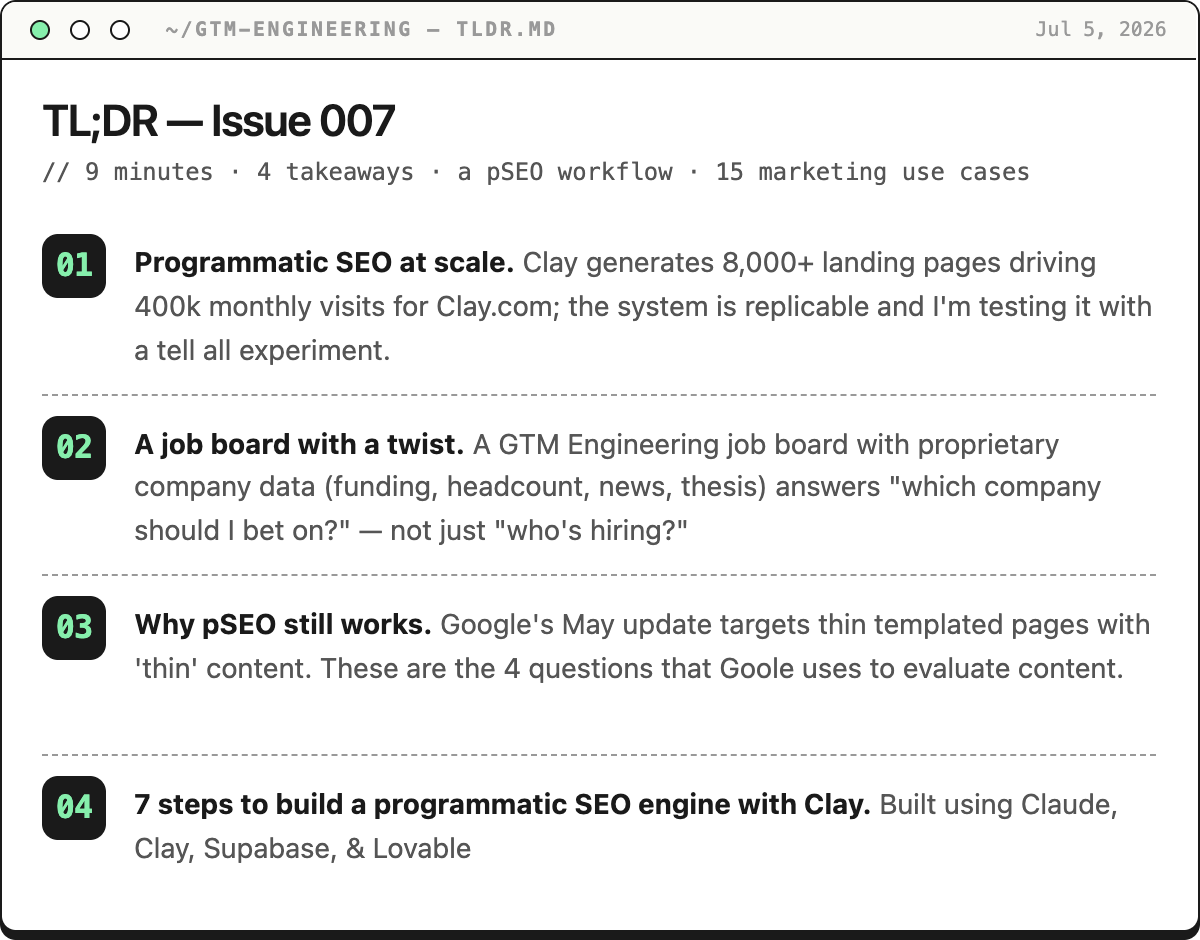
25% of clay.com’s web traffic comes from programmatic SEO. That’s 8,000 landing pages generating ~400k visits every month (1.6M total).
The best part?
The system is easy to replicate with Clay. I’ll show you how in this newsletter.
Then I thought, what if I run an experiment to see if the same approach can drive faster subscriber growth for The GTM Engineering Newsletter. Had to do it. I started building.
That’s the experiment I’m kicking off.
And I’m going to share everything with you:
The workflow
How to build the system step by step
What I’m tracking
Metrics
SEO & AEO best practices
What I’ve learned along the way
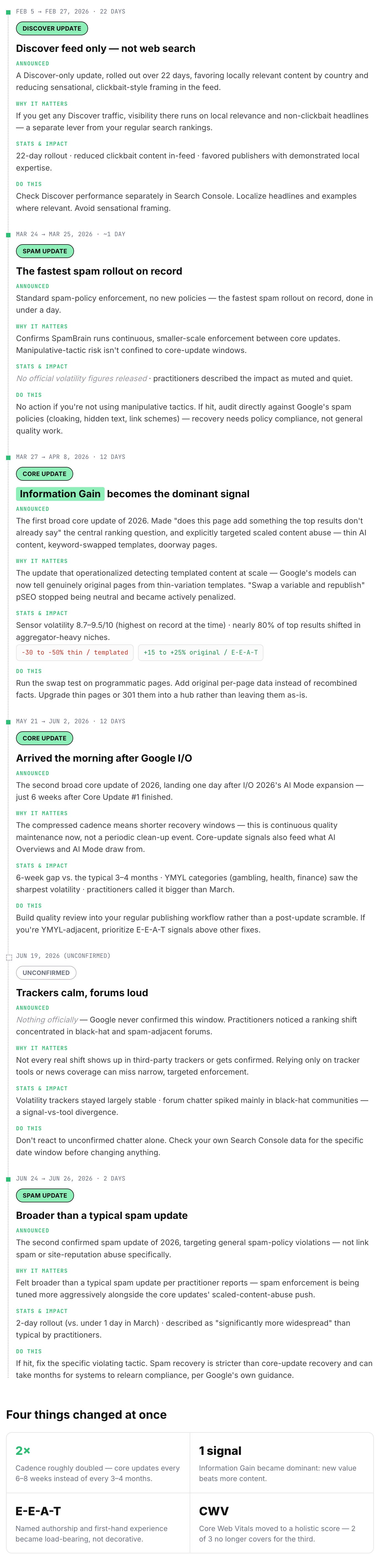
Just as I was finishing the first MVP (and super excited), I learned a few weeks ago (May 21) Google shipped a core update that specifically targets this type of approach - templated landing pages that simply replace variables with keywords.
Then there’s AI and the internet yelling SEO is dead.
So, is it working for Clay due to the brand or something else? And, will it work here?
Is SEO dead or has it just evolved?
The hypothesis: a GTME job board as a growth engine
The goal is to attract more GTM Engineers or any GTM Operators interested in the field.
Here’s what that person is doing right now:
Searching for GTM engineering jobs
Researching companies who are hiring
Comparing salaries as they range widely
Figuring out how to prepare for those interviews
Based on the 2026 State of GTM Engineering, hiring exploded during 2025, with over 3,000 open positions by January 2026 and compensation ranging from $60K to $250K for roles with specialized AI skills. The role is hot.
Report was in collaboration with Maja Voje who writes GTM Strategist and Garrett Wolfe who writes Garrett's Growth Substack. Both are great, check them out!
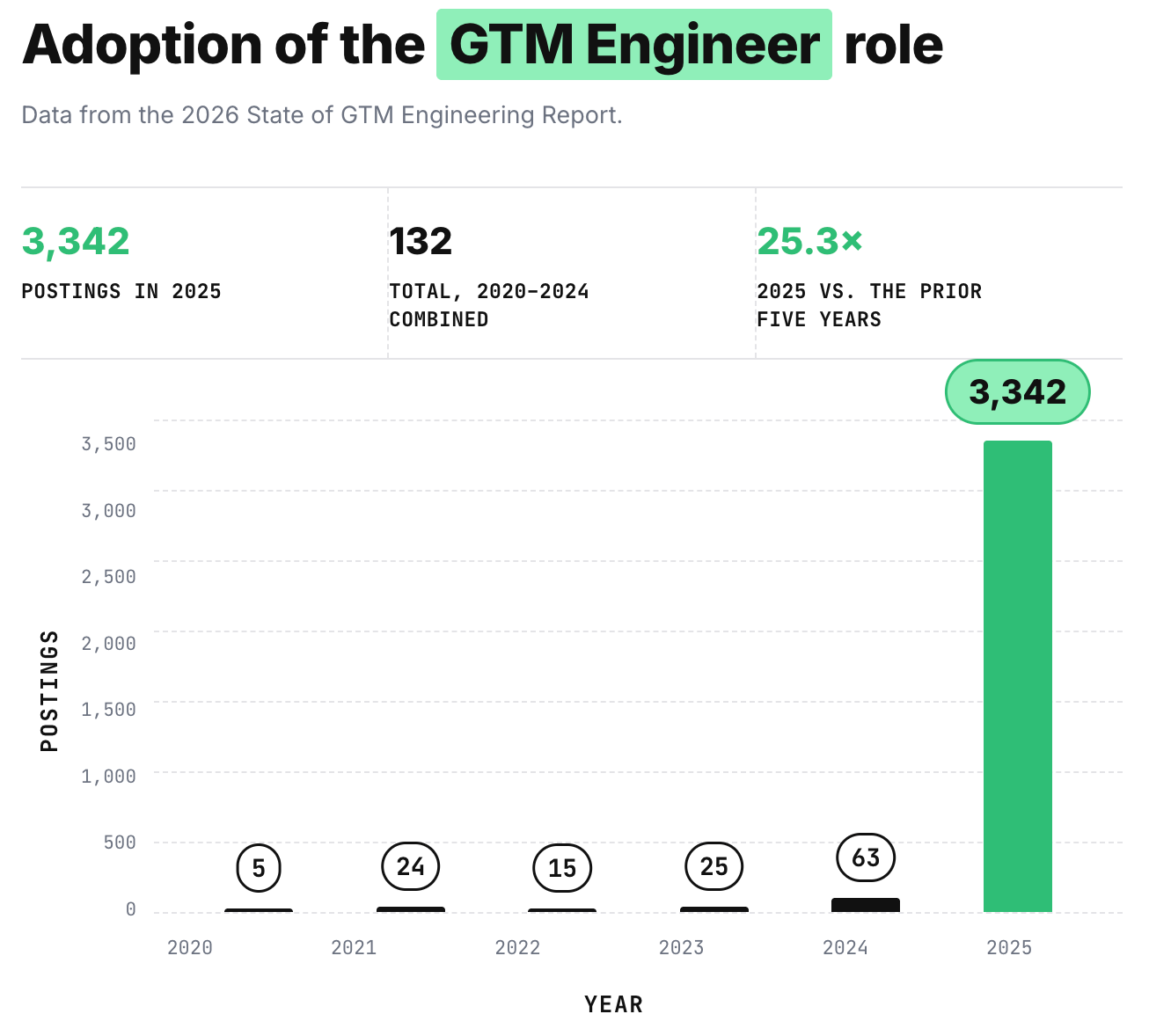
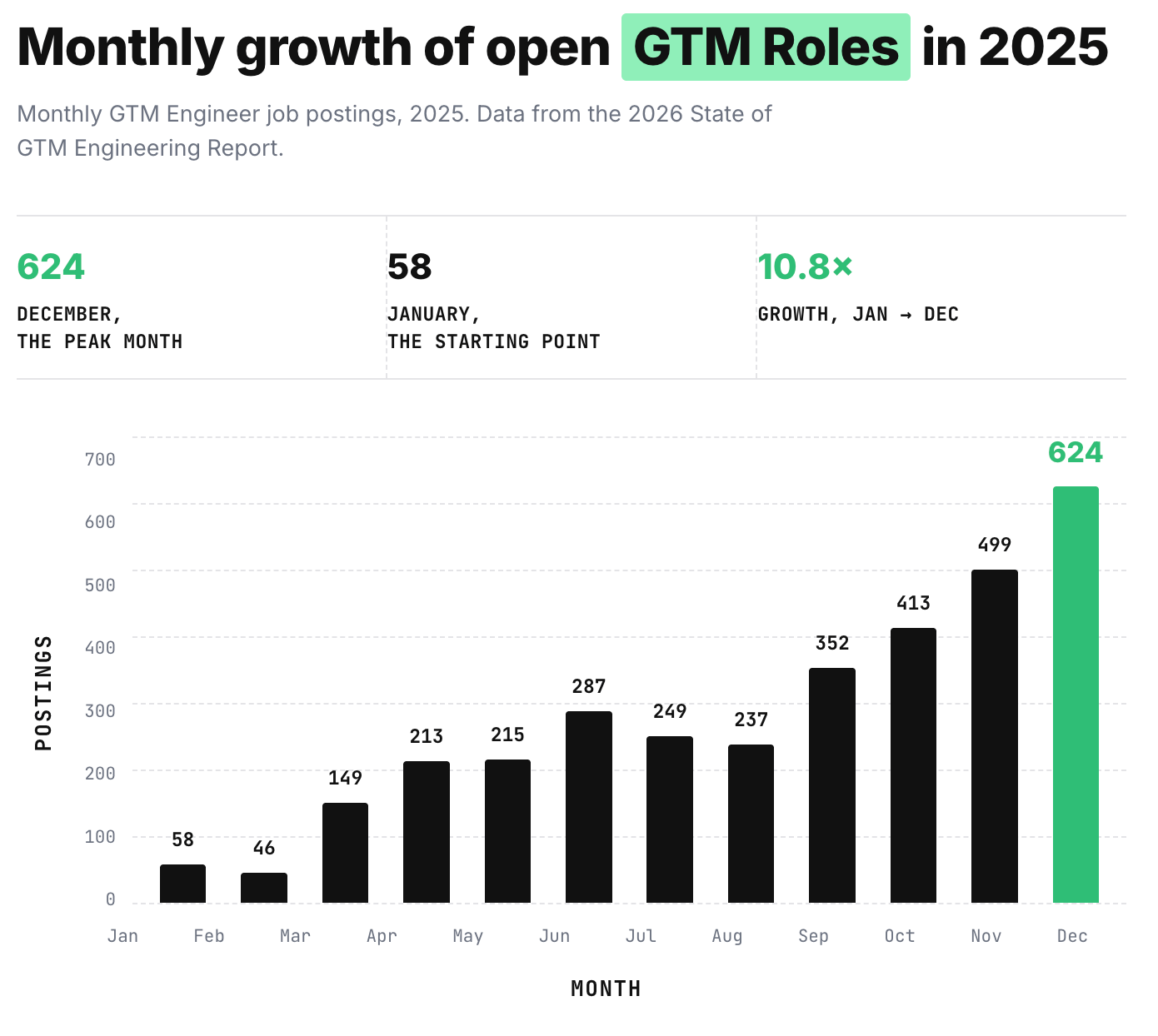
A standard job board would capture some of that traffic. But standard job boards are boring. You scroll past 40 listings, maybe save one, close the tab.
There’s no reason to come back tomorrow.
There’s definitely no reason for AI to cite you.
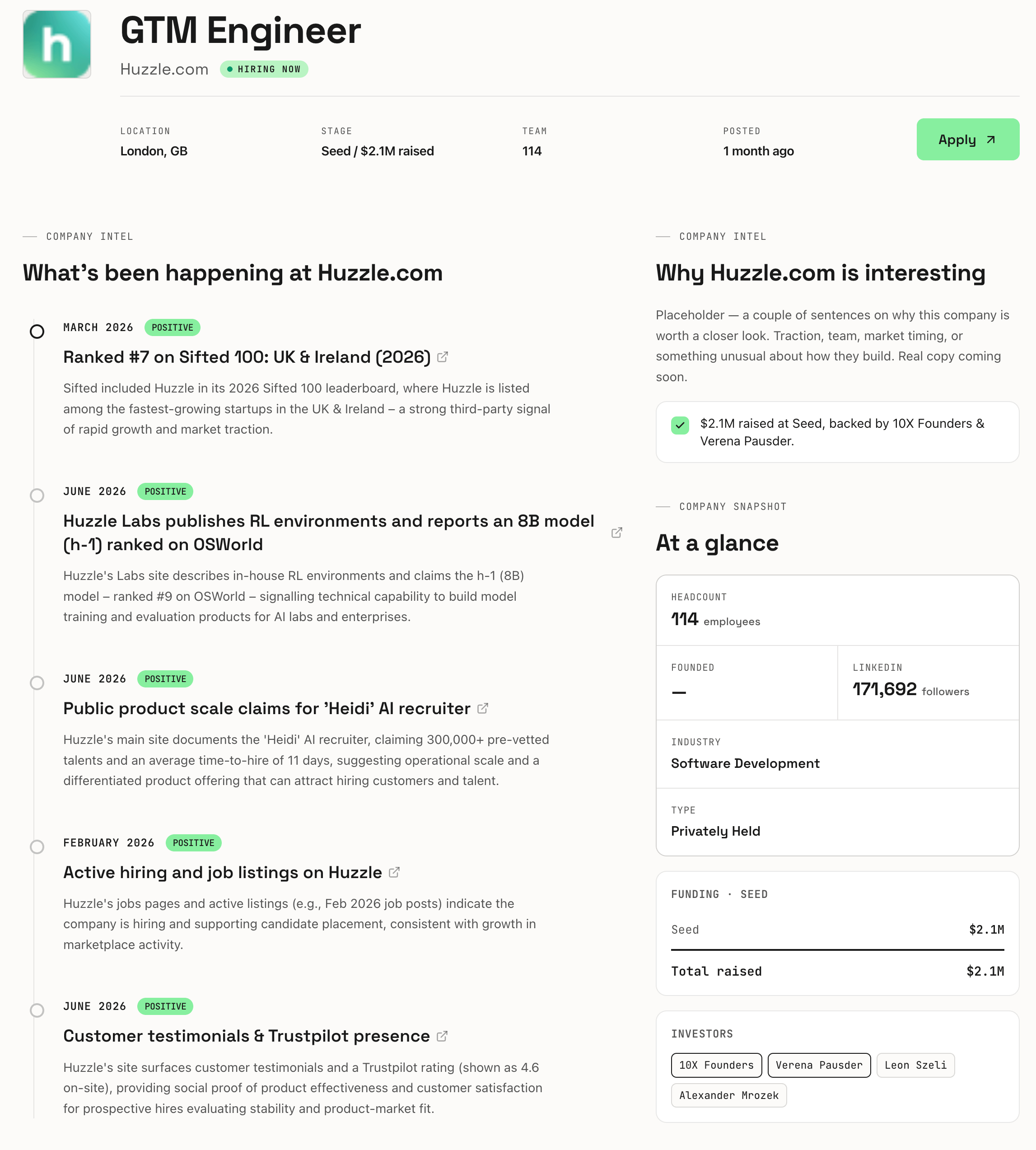
Here’s the twist to solve both: every company page on this job board includes a research layer that helps you decide if it’s actually worth joining. Not just salary ranges.
The stuff you’d want to know before you quit your current job:
Funding history and total investment raised
Investor tier (who’s backing them — a16z or a no-name rolling fund?)
Employee growth rate over the past 12 months
News momentum — is the company getting press or going quiet?
Why the company is interesting — actual thesis, not a copy-paste of their careers page
Competitive landscape — who they’re up against and how they’re positioned?
Technographics — is it a stack you know?
A GTM Engineer who’s job hunting isn’t only asking “who’s hiring?” They’re asking “which of these companies should I bet on?” And “who will be the best for?
The reason most programmatic pages fail is that they’re thin.
This is a data problem.
The test: if you stripped out the company name and the remaining content was still generic, the data isn’t doing enough work. Claygent-enriched company profiles with funding history, investor tier, and headcount trajectory is proprietary data a generic AI couldn’t generate without the same toolchain. That’s what makes a page worth ranking — and worth citing.
Example GTM Engineer job post page
More data coming soon… the build is still in progress.
Before we get into the build, lets dive into a few primers.
What programmatic SEO?
Quick definition for anyone who hasn’t touched this side of GTM: programmatic SEO means pairing a data source with a template to generate pages automatically instead of by hand — “best CRM for [industry]” times two hundred industries, or in my case, one page per open GTM engineering role. The technique is as old as SEO itself. What’s changed is the bar for what counts as a legitimate page versus a doorway page Google is now actively hunting.
Why “pSEO is dead” is the wrong read
Google’s May update arrived days after Google I/O 2026, where the company announced AI Overviews had crossed roughly 2.5 billion monthly users and AI Mode had passed 1 billion — plus a new AI-powered search box the company billed as its biggest search change in over 25 years. Read the two announcements together and the message is coherent:
Google is getting more aggressive about surfacing answers directly, which means it has less patience for pages that don’t add anything beyond what the answer already contains.
Clay’s own team is the clearest evidence that the response to that isn’t to stop building programmatic content, but to stop treating it as fire-and-forget. Clay maintains a library of over 8,000 “dossier” pages: detailed company and executive profiles built to answer questions people are actually searching. Instead of letting them go stale, Clay built a Clay table that pulls each page’s content from Webflow, checks whether the underlying data has changed, rewrites the stale sections with an LLM, and pushes the update back to the CMS automatically. What used to be a two-week content cycle — keyword research, brief, draft, edit, publish — now runs in about three days, on a continuous loop.
Comparative search volumes
Google’s own disclosure puts it at roughly 5 trillion searches a year — about 13.7 billion a day. ChatGPT’s total prompt volume is enormous, but the slice that actually functions like a search query is much smaller: independent clickstream analysis from firms like Ahrefs and SparkToro puts genuine search-like ChatGPT activity in the tens of millions of queries a day, not billions.
This is why you need both SEO & AEO.
The SEO updates from Google this year
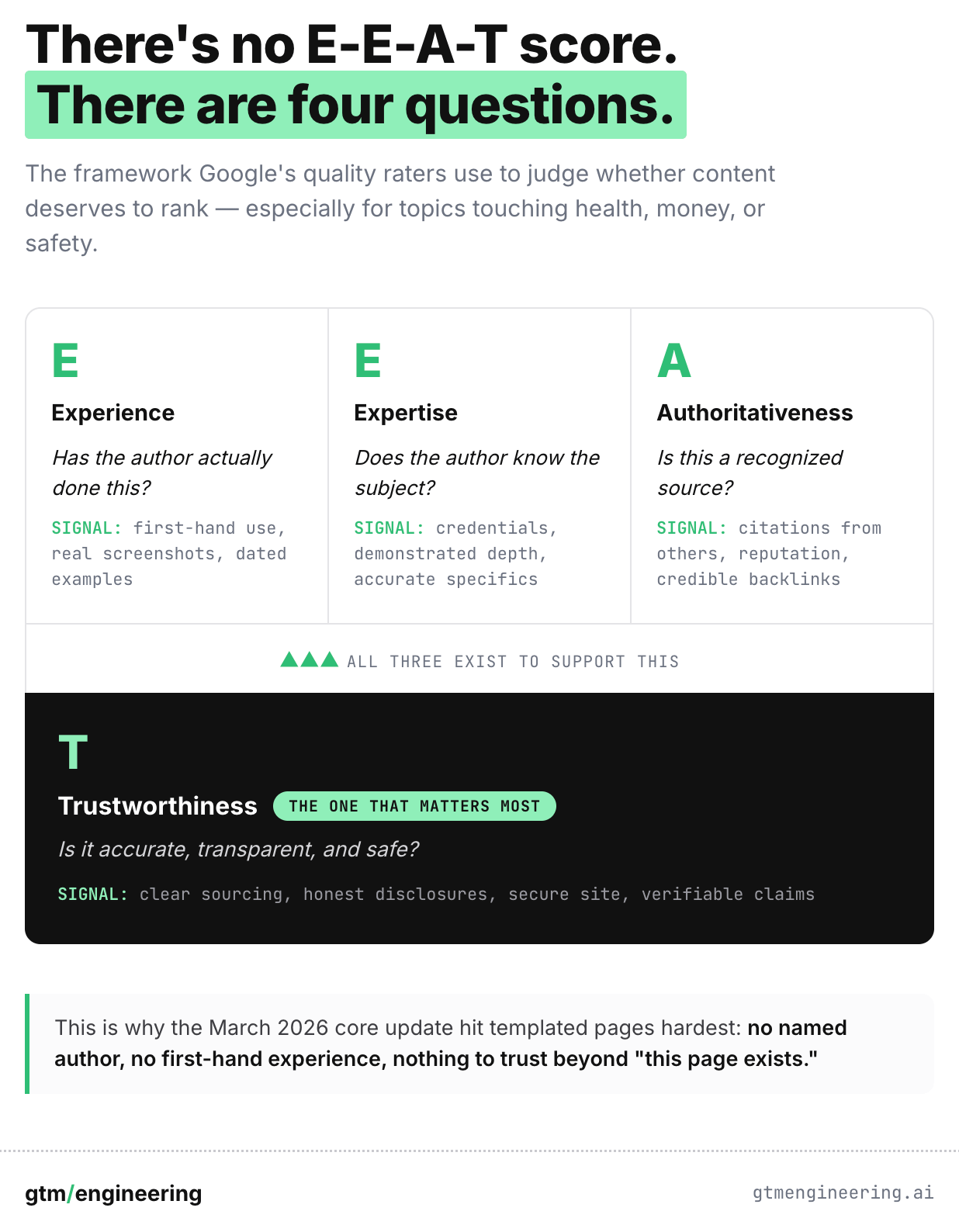
What is E-E-A-T and how does Google judge content?
How do you build a programmatic SEO engine with Clay?
This is the high level workflow:
Step 1 — Design the job board in Claude Design. You can also do this in Lovable. I just have my design system setup in Claude Design.
Note: There’s 2 ways you can send this to Lovable: 1) MCP connector 2) Asking Claude for an HTML download and prompt to recreate it in Lovable
Step 2 — Open job signal detection Clay table. A Clay table monitors job postings for open GTM Engineer roles. When a new role appears at a company we haven’t seen before, it gets added to the table and triggers enrichment
Step 4 — Enrichment workflow with agentic research. Multiple Claygents researches each company: funding history from Crunchbase, investor tier classification, LinkedIn employee headcount over time, recent news via web search, etc. To get a unique data point, we can come this to data that was found in the ‘26 State of GTM Engineering Report.
Key: you also need a column that generates a unique URL slug or each page.
Step 5 — Send data to Supabase via HTTP API. This is our database layer that Lovable will pull from to generate the pages. Once the job openings in Clay are enriched they’re sent to Supabase (that is managed by Lovable) via an HTTP API column.
Key: copy the JSON Body in the HTTP API column and tell Lovable that you need the Supabase table to support the variables and update the DB
Step 6 — Supabase as the data layer. Enriched company records land in a Supabase table. This becomes the source of truth that feeds the site. When the Clay table refreshes weekly, Supabase updates automatically.
Step 7 — Lovable generates the pages. Each company gets a landing page on gtmengineering.ai, populated from Supabase.
There’s some additional work & prompting to build the site, but more on that + AEO best practices in upcoming posts.
Programmatic SEO is not the only Clay marketing use cases. There’s actually many…
What are Clay’s top marketing use cases?
Account Based Marketing
Events
Advertising
Trigger based campaigns
Lifecycle marketing
Automated inbound follow ups
Dark funnel (personal emails to work identities
Content generation
AI lead qualification
Programmatic SEO
Competitive research & monitoring
Customer intelligence mining from call transcripts
Data analysis
List building
Content localization
The list goes on… and there’s multiple use cases within each category.
Coming up in Part 2
I likely won’t have results yet, so I’ll plan to go deeper on the technical aspects of the experiment:
Reveal of the site
SEO page best practices
AEO 101 and best practices
Tips from AEO experts
Monitoring