


New here? Hi, I’m Alex Lindahl, Creator in Residence at Clay.
Join 8,700+ GTM operators from OpenAI, Reddit, a16z, Figma and some of the fastest growing companies who subscribe.
Dropping Clay’s 1st Benchmark
This is one of my first projects as Clay’s Creator in Residence. Check out 👉 Clay’s 1st GTM Engineering Benchmark: Speed to Lead. 👈 We orchestrated thousands of agents to fill out 6,436 B2B contact forms. We analyzed:
Speed to lead (email & call back)
Personalization level
Form size
ICP Fit of lead
Industry & Company size
A personalized report is generated for company’s we tested!
How to break into GTM Engineering (with no experience)
There are thousands of people who want to break into GTM Engineering. If that’s your goal, then this is for you.
If you’re hiring, then check out the flip side of this How to hire a GTM Engineer.
This is what I’d do if I had no experience as a GTM Engineer. (Based on 100s of conversations with GTM Engineers and 100s of companies I’ve helped adopt Clay over the last 2.5 years.)
The majority of content focuses on scaling cold email infrastructure. Some of the most popular content on LinkedIn are infographics that tout a zillion tools strung together. This is not where to start. It also doesn’t define what a GTM Engineer does or what will provide value to your company.
The best way in is to build your way in.
This is the process I’d take that helped me became a Creator in Residence at Clay and from what I’ve seen work.
I’ve also included a list of resources I’d recommend.
How I made the transition: GTME to Creator
Nobody at Clay handed me a new title or told me to go build a newsletter. I was in sales, closing deals, and sprinkling in some Forward Deployed Engineering work. On the side, I started to share what I was learning: how to use Clay and use AI in GTM. No one asked me to. Claymation (the original newsletter was born) that I rebranded to The GTM Engineering Newsletter.
I became obsessive about posting on LinkedIn. Almost all of it about Clay and what’ve learned working at a series of unicorns.
Then I started r/gtmengineering.
That’s 3 surface areas where audiences started to grow. I shipped content on a regular cadence and resulted in some decent numbers so far:
GTM Engineering Newsletter 👉 now at 8,600+ subscribers
Reddit r/GTMEngineering 👉 16,000+ members
Personal LinkedIn (connect with me) 👉 nearly 27,000+ followers
Moving out of sales had been on my mind for awhile. I knew writing and building in public could lead to something because that’s how I landed at Clay.
I shared this with leadership and met with Jake Block, Head of Media, who had just joined. We talked about doing a YouTube show, GTM Engineering & AI, which is now live. (Subscribe for an upcoming episode on how Lovable uses Lovable.)
The seed was planted and I kept building.
Then at the end of last quarter, the Media Team was ready. I’m now 1.5 months in and I haven’t been this happy in a role in very long time.
As you can imagine, it’d be hard to make the case to join the Media Team without any experience. Especially, at a company with a high bar for craft and pretty much everything.
The same is true to if you want to become a GTM Engineer.
This is what I’d do to become a GTM Engineer (if I had zero experience)
First note - you can come from the engineering side or the business side. The guidance would be he same. You just need to become proficient on your weaker side. An engineer must have the aptitude to learn the business side. A sales rep (or anyone on the business side) must have the aptitude to learn the technical side. To become a GTM Engineer, you need to have both skillsets.
Step 0: Apply to Clay’s $1M GTME Scholarship Fund & find your resources
Apply! We’re funding people to take courses, join cohort programs, and learn. There’s an internal mission to help the next 1,000 become GTM Engineers. Check it out and apply here.
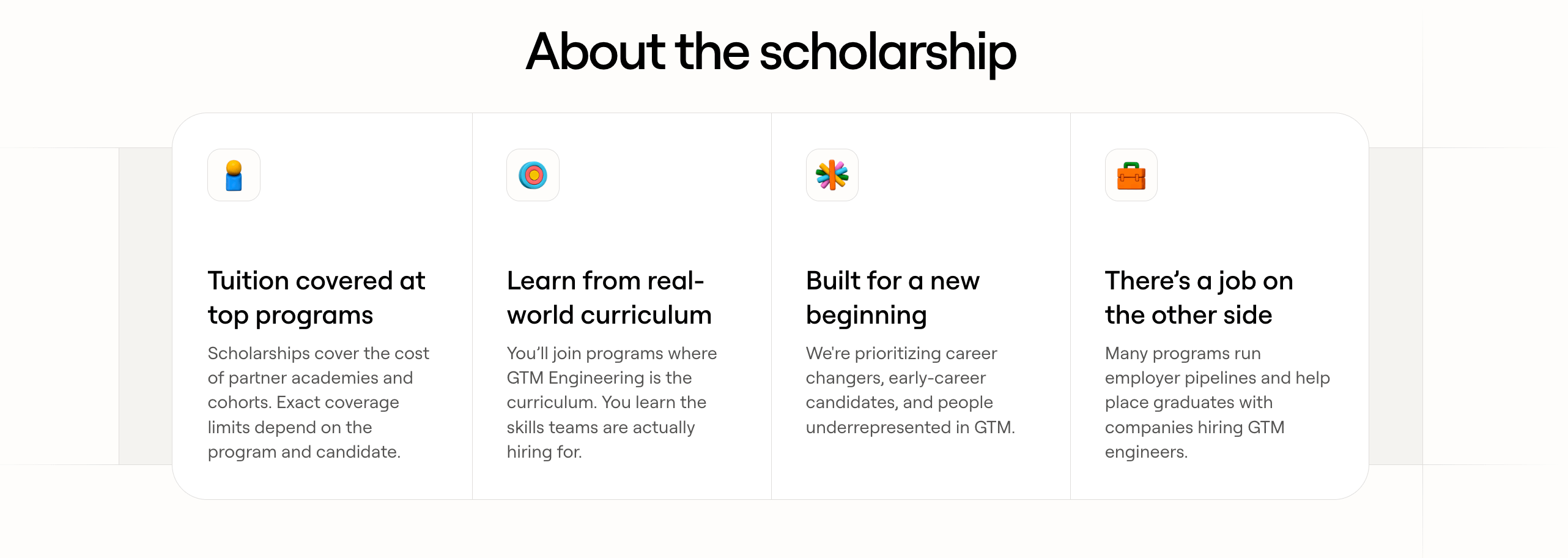
In parallel, consider taking a course to learn the fundamentals. There’s free and paid programs. Plus newsletters, media, and communities to join. My recommendations:
Clay: Clay University | Alpha Forge Clay Bootcamp | Clay Cohorts | Maven Series Building an AI GTM Engine
Communities: Clay Slack Community | r/gtmengineering | Clay Clubs (local) | Unlock GTME | Clay Cafe
Paid Schools: The GTM Engineer School | Bootprint
YouTube: GTM Engineering & AI | Eric Nowoslawski | Tim Yakubson
Newsletter short list:
GTM Engineering Newsletter (consider me your insider at Clay)
The GTM Engineer (by Clay)
The GTM Engineer & Podcast - Experiments, interviews, how tos
The GTM Engineer Pulse - Roundups by the GTM Engineer School
The Short List - GTM Engineer job post roundup
The Workflow - Detailed GTM workflow guides
RevOps Impact - You’ll need to learn some RevOps. This is my go to.
The GTM Strategist - On building AI-native GTM
FullFunnel - GTME guidance from one of Clay’s top agencies
Know your Growth - from Clay’s Head of GTME Ecosystem, Yash.
I also put out daily content on LinkedIn if you want to connect with me.
Step 1: Pick a metric that matters right now at your company
Sales productivity, pipeline generation, something the customer success team feels every week. It should already be on leadership’s radar, not something you have to convince them to care about.
This is the thing you want to impact.
Here’s a few metrics to consider:
Speed to lead (check out the 2026 Speed to Lead Benchmark)
Outbound capacity per rep
New meetings per week (for sales reps)
Ad match rates
Rep ramp time
Pipeline generation
Expansion pipeline
CRM data quality
Step 2: Understand how the system works today
Dive into the people, technologies, and processes that are behind getting to that metric. Do this through informal conversations at your company.
Questions to consider:
Can you show me how you do X today?
Who owns this process?
What providers are we using?
Can you walk me through this system step by step?
Where are the handoffs?
Step 3: Discovery to find the bottleneck(s)
I’d do this through casual conversations with the people living in the process and experience the pain of whatever that bottleneck causes.
Your goal should be to get multiple data points from many people. Not everyone will give you the same answer and its your job to triangulate and properly diagnose.
Questions to considers:
What’s preventing you from moving faster doing X?
Where do you spend your time?
Can you walk me through how this is done today?
What providers are behind X and how do they work together?
What do you think the bottleneck is?
Step 4: Build something that solves it
Start with a hypothesis and think about how you’ll measure whether what you’re building improves the metric or not.
Now start building. It could be a workflow, a skill, a Claude Artifact, Codex Site, Grok Bot, or a simple prompt. Whatever you choose needs to move the metric you want to impact. Think of the person you’re helping as a design partner. I’d break up the project and ask for feedback at each stage.
“But Alex, we don’t have a Clay subscription. How can I get some Clay credits?”
Good question! Here’s a few ideas:
Apply to Alpha Forge - Clay provides 20k free credits as part of the program.
See if you can expense a Launch Plan (starts at $167/month)
Hit up Clay sales and we could potentially turn the project into a real POC (reply if you want help to connect). We provide some free credits during this period. You would need to bring in the right people to ensure there’s some sponsorship behind the use case.
Referral program gives you and whoever signs up for a free version 3,000 free credits each.
If you need help conceptualizing how to build what you’re aiming to do, drop in the chat and I can provide some thoughts.
Also, don’t miss this opportunity to use our newest tools such as Workflows and Agent Plugins (Grok Bot is my new favorite):
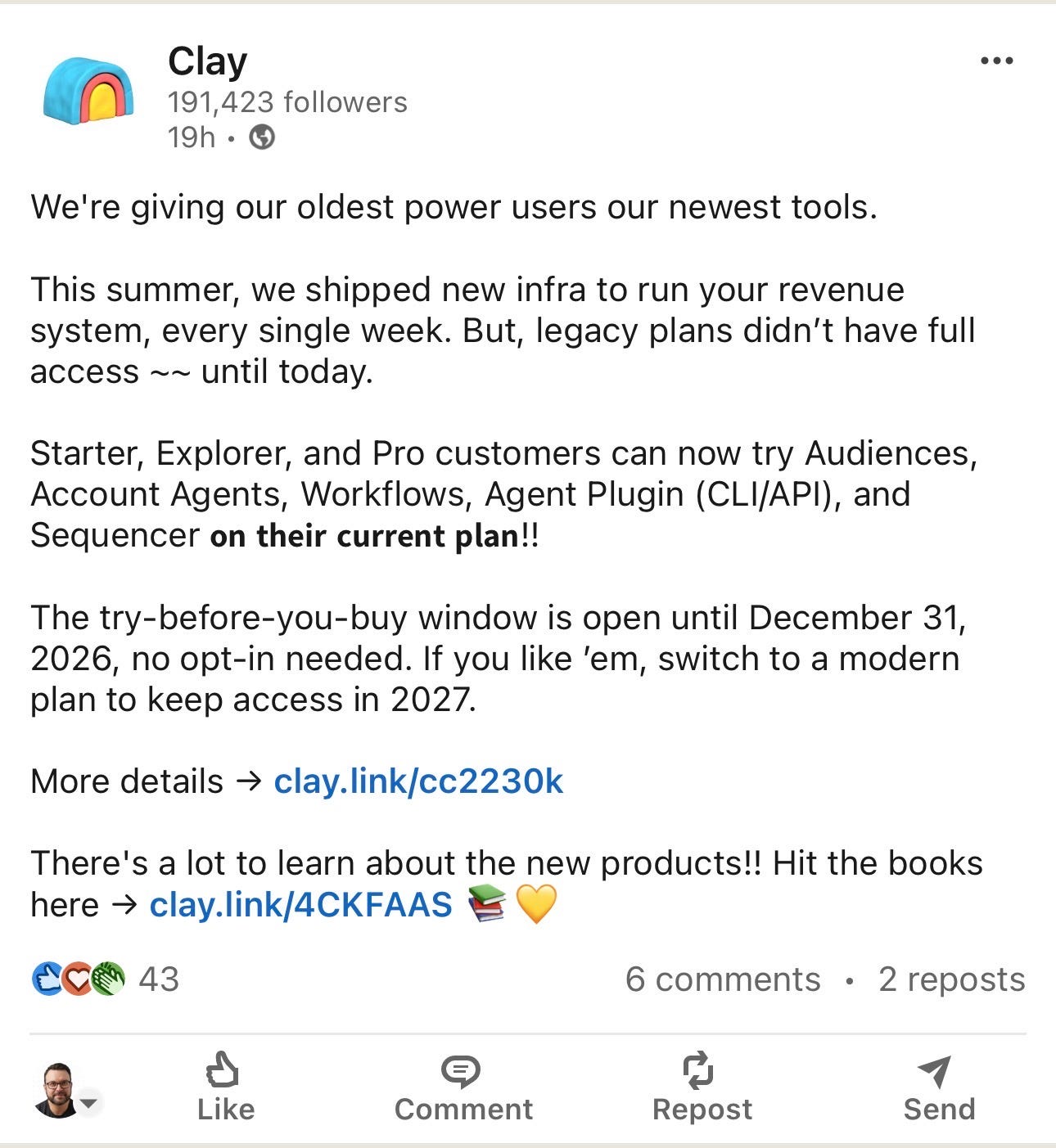
Step 5: Deploy it for someone, measure, and improve it
Get feedback, iterate, and turn that person into a genuine fan of what you built. You want them telling other people about it before you do.
Be sure to:
Track results
What worked?
What didn’t work?
Document
Share what you learned
Step 6: Repeat steps 1-5, tinker, experiment to get “AI-pilled”
Remember, the goal is to build your way in.
The only way I’ve gotten better at using AI is to tinker and experiment. You’ll begin to form a mental model of what’s possible and how to use AI as a building partner instead of search box.
A few tips to accelerate your productivity using AI:
Ask AI to interview you for context - “Before starting, interview me for any additional context or clarification you need.”
Tell it your objectives - “My goal is to build a landing page that converts views to signs ups.”
Give it examples you like - “Use [insert website] as inspiration. I specifically want X to be like Y on my site.”
Ask AI how it’d improve it - “How would you improve this hook [provide your hook] to drive engagement on LinkedIn?”
Ask for variations - “Create 3 different variations of the chart design that we can riff on.”
My favorite thing to tinker with right now is Grok Bot. It can log into sites and even scroll LinkedIn to find examples for you. The possibilities are infinite.
Step 7: Build pull
People should be coming to you with questions about AI because you’ve become more visible internally & helped people.
If that pull isn’t happening yet, you haven’t found the right bottleneck, shared enough, or you haven’t unlocked the use case someone actually cares about. This takes time.
There is another possibility worth calling out. Sometimes the pull isn’t missing because of what you’re doing. It’s missing because the company you’re at is a laggard, with leadership that isn’t leaning into AI, new ideas, or willing to try anything new. That’s not a sign to try harder. You might need to find a company that does.
My take is that you’ll be held back by a company that doesn’t invest and lean into using AI. This doesn’t mean giving people a Claude subscription.
This is also where community can really help. Especially, showing up to in-person events. You’ll optimize your chance of meeting someone who might be hiring or can make the right introduction. Pull rarely happens in isolation. You’re simply increasing your surface area to get lucky.
Step 8: Build your business case
By now you should have a compelling story, proof points that show impact, and a couple of internal champions. You might have to educate leadership on what GTM Engineering even is. Case studies help here, and there are plenty online now.
Make the ask. Go to leadership and make the case to do this full time.
Note - make sure this isn’t the first time you engage with the leader. You’ve ideally built up rapport along the way and they have some idea about what you’ve been up to ahead of time.
Step 9: Then go build in public
Ideally you become known for something specific, like GTM Engineering for cybersecurity. That specificity is what makes the next move easier, whether your company promotes you or somebody else comes calling.
How to choose the right company
Let’s say you don’t want to stay. Before
I’d start a bit different on this one. You first need to optimize:
Growth stage
Industry
Tech Stack
Growth stage
A Series A startup and a Series D company are quite different. So is a 3,000-person org, and a Fortune 500 tanker. Some people thrive in ambiguity and building zero to one with no roadmap. Others need structure, and they do their best work designing systems that scale inside a process machine.
There are two reasons this matters. The first is fit: where will you actually be happiest, do your best work, have the right scope, and make the largest impact? The second is tactical: this choice shapes your entire game plan for breaking in. You prepare for an interview (and the job) differently for a scrappy Series A than you do for a company three layers deep in process.
Industry
Pick an industry or niche. AI-native companies, cybersecurity, dev tooling, insurance, whatever pulls you. This does three things at once. It gives you a shot at becoming the expert GTM Engineer in that segment, where expertise meets branding. It lets you build a targeted wishlist of companies you want to work for, split between the ones that already have a GTM Engineering function and the ones that don’t yet. And it tells you exactly what to spend your learning hours on instead of everything at once.
Tech Stack
Industry isn’t the whole picture either. You’ll also want to look at the company’s GTM motion(s) and ask what excites you: PLG or enterprise sales, B2B or B2C, partner led or direct sales. A company like Wiz (a cybersecurity company), selling top down to large enterprises, needs completely different workflows and systems than a PLG company like Clay. Once you know your motion, three things get a lot clearer. What workflows to learn inside and out, since that becomes your portfolio. Who to learn from, if I were focusing on PLG today, I’d go find 10 GTM Engineers already working inside PLG companies and learn directly from them.
My favorite bootcamp success story
If you think you need a head start to make this jump, I’d point you to Nayab Osaf. She started cold-calling at 16, freelanced in HR, and got haggled down from $15 an hour to $13 on jobs that barely paid to begin with. She had zero technical background when she saw a posting for a Clay Bootcamp coaching role. She applied anyway, learned the platform in two weeks, and started teaching CEOs and sales leaders how to use it while still working through her own imposter syndrome. She now runs an agency with her husband charging $8,000 to $10,000 a month per client for the same kind of GTM Engineering work this guide is about. Ten to thirteen times what she was making before.