


New here? Hi, I’m Alex Lindahl, Creator in Residence at Clay and one of the first GTM Engineers.
Join 8,700+ GTM operators from OpenAI, Reddit, a16z, Figma and others who subscribe to learn how the fastest growing companies build better AI-native GTM systems. W
The next $1T company will be a software company masquerading as a services firm. - Julien Bek, Partner at Sequoia Capital
The opportunity to build AI GTM agencies is enormous.
While efficiency gains will reduce demand for some traditional services, BCG’s analysis shows that agentic AI will ultimately expand the total addressable market for technology services—unlocking up to $200 billion in net new value pools in the next five years. - Boston Consulting Group
$6 is spent on services for every $1 spent on software. Deploying AI isn’t the same as SaaS. This is why the Forward Deployed Engineer model is critical for companies selling AI.


That got me wondering, how do you start an agency that focuses on this deployment layer for AI GTM. And, can you do this as a solopreneur?
This led me to Jeff Ignacio who runs RevOps Impact. This is a recap of Jeff’s AMA on the GTM Engineering subreddit (1,500 join every month) and the advice he shares. He covers:
How he got started
The pitch vs. the practice
How he positions his services
Where he finds clients
His 4 call discovery to close process
How agents are used to scale
Advice for others starting
Lets dive in.
How to build a $1M solo AI GTM agency
How Jeff got started
Jeff Ignacio’s first clients came from people who’d already worked with him. When word got around that he’d left his VP of RevOps job, former employers and colleagues called. It took years of groundwork before that could happen.
He didn’t start in RevOps. He was a management consultant working on requirements for large ERP rollouts, then did an MBA and spent a few years in FP&A. He moved into sales ops in his thirties and called the switch “a headspinning venture.” He “powered through it working late nights and taking W’s and L’s along the way,” and worked up to running RevOps.
Along the way he did the thing most operators put off. He built a following on LinkedIn for years, then carried it into a Substack, the RevOps Impact Newsletter , which now reaches more than 6,000 RevOps leaders. So when he went independent, people already knew how he thought about revenue operations. The referrals came from that.
Year one has been “fraught with the rollercoaster ride of trying to get something up and running,” he said. “Having your back against the wall is a mentality I didn’t have as a W2. But it’s ever present in my new role!”
Don’t (only) sell Clay, sell judgement
Jeff described himself as “a combo of solo fractional RevOps that happens to do some GTME work.” Most clients bring him in as an interim Head of RevOps. Clay work is real, and “a huge opportunity over the last eighteen months,” because many teams don’t have the technical skills to use it well. But it isn’t the main thing he sells.
His positioning fits in one sentence: “You get someone who can wax poetic on business strategy AND work with your technology.” He’s clear that this works at Series A to C and less so at public or late-stage companies. He’s fine with that.
He also doesn’t own the stack. He builds inside the tools a client already has, or prototypes an alternative and lets them choose. For a solo operator I think that’s right. Owning the stack means owning uptime, and a person who owns uptime for eight clients can’t take a vacation. But it’s a choice, not a law. A GTM engineer who wants a real agency, with recurring revenue that doesn’t depend on their hours, will eventually have to sell managed systems. Jeff has decided not to be that business.
Where the clients come from now
Past the first wave of referrals, Jeff keeps his pipeline full the slow way. He builds partnerships with software vendors and other consultancies. He works with VC and PE firms to find portfolio companies that need help. He posts honest updates on what is and isn’t working.
His best channel is in-person networking, “by far.” He hasn’t tried cold email or LinkedIn outreach.
That should make GTM engineers pause. The people building outbound systems for a living are getting their own clients through relationships. I don’t read that as hypocrisy. At a senior fractional price, trust matters more than volume, and a warm intro closes faster than any sequence. If your offer is a $3k Clay build, you probably need outbound. If it’s a $15k a month interim executive, you need people who’ll vouch for you.
That’s also why his advice for someone in a GTM job today is to moonlight.
Most of the agency owners I know today started by moonlighting.
Get good at the work in your current seat, then talk about what’s working, without sharing anything proprietary, in the communities you belong to. You’re building the reputation that sends you your first clients.
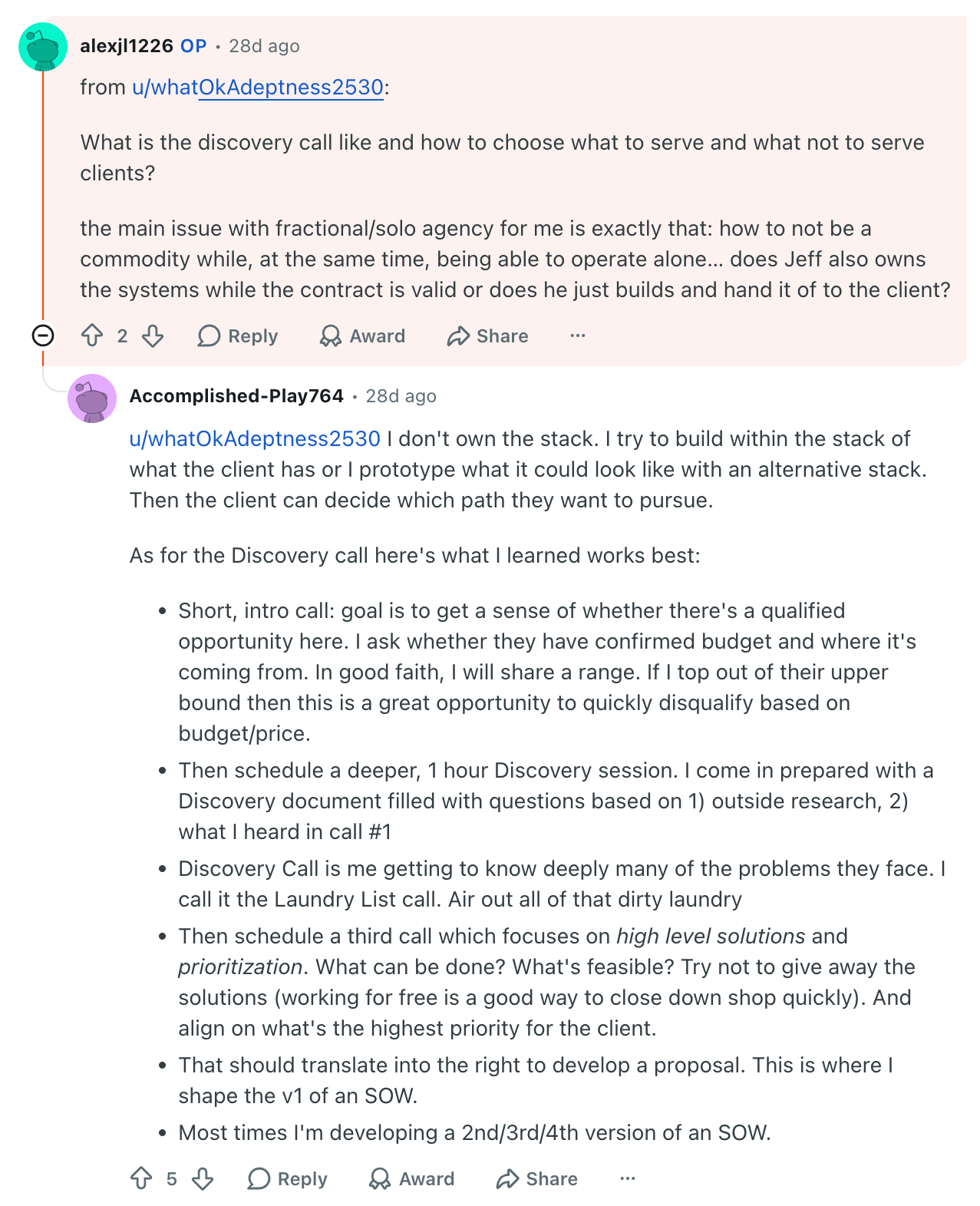
The four-call discovery → SOW process
This was the most practical answer in the thread. Jeff’s sales process:
Intro call
1 hour discovery
High level solutions & prioritization
SOW & proposal review
Step 4 sometimes takes a couple iterations. This was his exact response on Reddit:
Where agents fit, and where they don’t
When I asked how he uses agents to scale delivery, Jeff listed Claude plus agents he builds himself:
List building for sales and marketing targeting
Data hygiene for territories, lead assignment and segmentation
Executive memos and weekly business reviews
Forecasting scenarios: the downside, the upside, and what has to happen for each
Pipeline management, spotting trends early
Most of it is the prep work behind an executive’s job: the memo, the forecast, the clean territory data. Agents compress the hours that used to go into preparing for the meeting. They don’t attend the meeting. That’s why the model scales by making Jeff more valuable per hour, not by adding clients.
What about bottlenecks?
The interim-executive model caps how many clients he can take: “My time can only scale so far.” He loses deals when a prospect wants a firm with several people, when he’s too expensive for a solo practitioner, when the client isn’t sure what they want and backs out, or when they try it themselves. That last group usually comes back about six months later.
He isn’t trying to solve the first two. He hasn’t decided he wants to grow past one person, and he likes the economics of a single-member LLC and the control over his time. “I just need my slice and that’s it. Don’t need to be greedy.”
So the honest version of the $1M solo agency, as Jeff runs it today, is a few senior clients at senior rates, with agents handling the grind. The version where agents do the delivery and one person runs twenty accounts might come.
Reddit AMA is TODAY
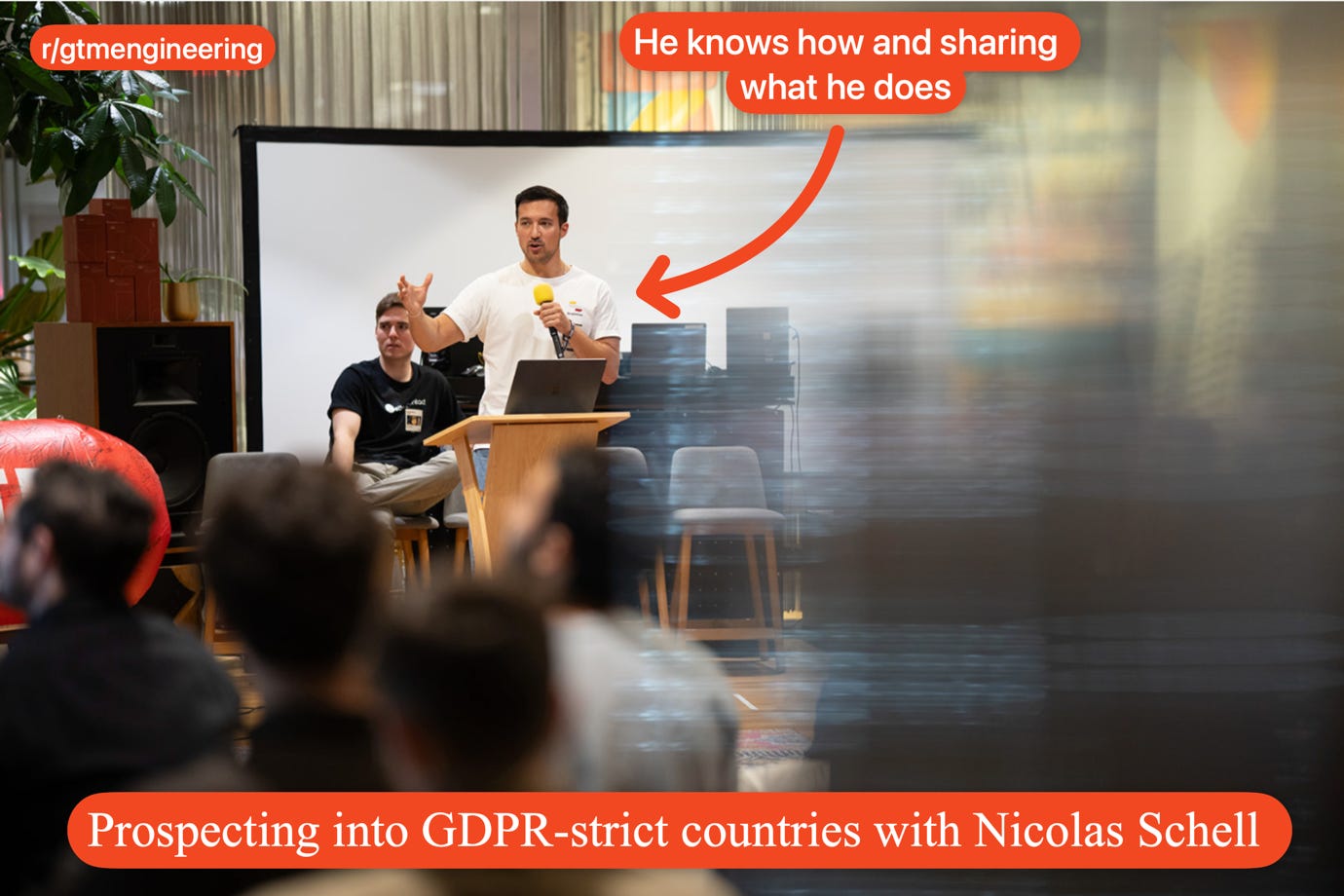
We’ll be joined with Nicolas Schell, co-founder of Scalantec, a boutique agency in Berlin who’s sent millions of outbound messages in Germany.
He’ll be answering submitted questions such as:
What are the boundaries between cold prospecting and warm prospecting in Germany, and what are some tactics that companies can deploy to shift prospects from cold to warm? And how does that change the legal dynamics for outreach?
Are there real risks to ignoring the strict consent rules? I’m sure someone at some point has gotten a fine, but it really seems like most startups just ignore it. Never heard of anyone getting caught, but that could just be my ignorance.
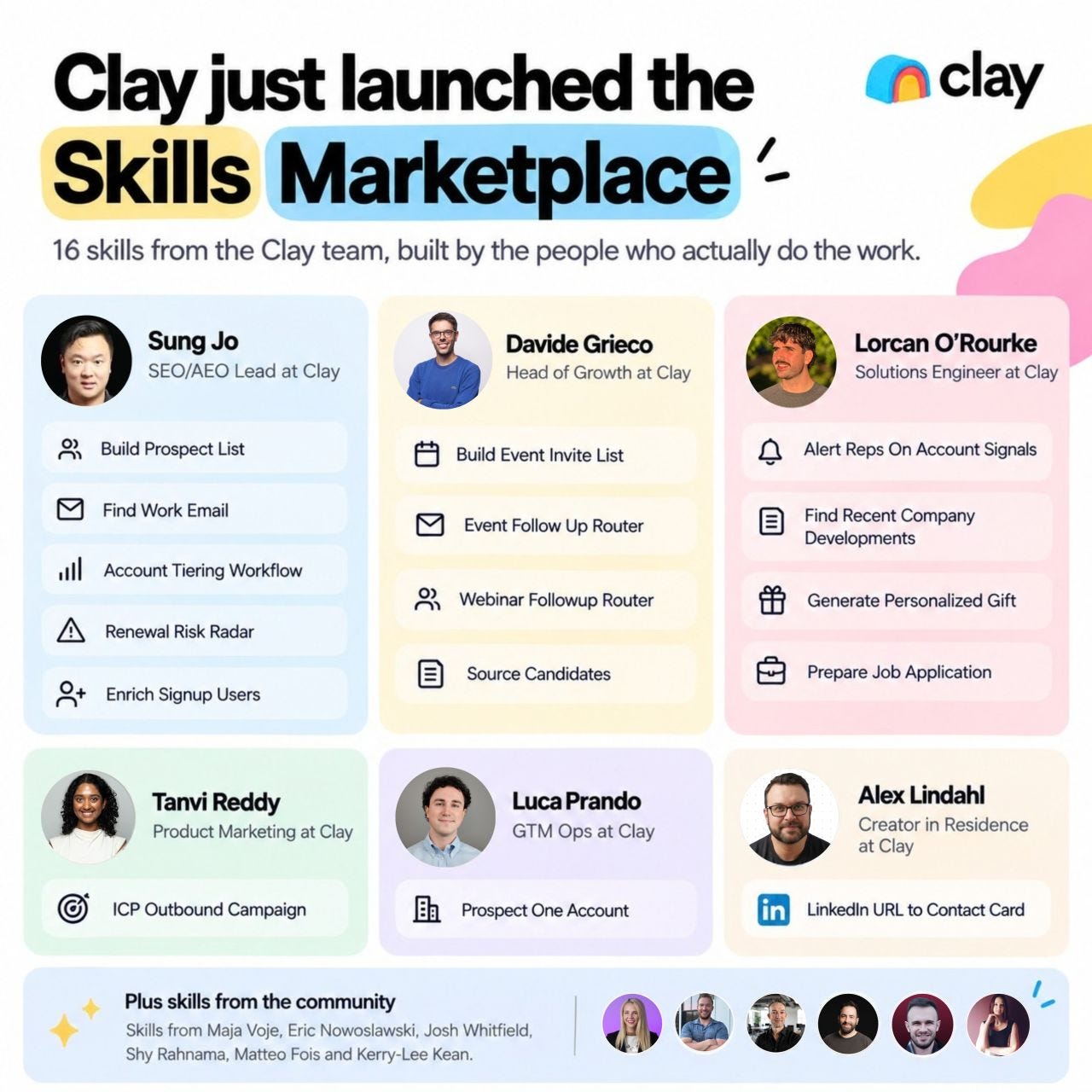
Clay launched an App Store (but for skills)
I’ve been looking forward to this for a while and previously wrote:

I loved this infographic from Yukta Kandhari that highlights some of the featured skills by creators (from Clay & the community):
Skill of week: org chart generator
I wish I had this as a rep.
Input a company. Clay researches the executive team. Claude builds an interactive org chat where you can:
Drag and drop to adjust reporting structure
Mark the buying committee (Champion, Executive Buyer, etc.)
One-click source work email + mobile number
Visually see how is new in role (3, 6, or 12 months)
Recent news with executive mentions
Copy & use in minutes: https://gtmengineering.link/org-skill
AI Run Club
I’m launching an AI Academy & community for GTM leaders who want to get better at AI. Check out our newsletter & let me know if you’re interested to learn more.
